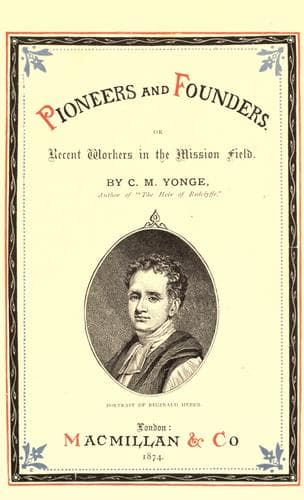
Pioneers and Founders: or, Recent Workers in the Mission fieldYonge, Charlotte M. (Charlotte Mary)
History
Pioneers and Founders: or, Recent Workers in the Mission field
Yonge, Charlotte M. (Charlotte Mary)
Missionaries
Duaterra, meantime, of his own accord, was making preparations for the
first Sunday service held in New Zealand. It was likewise the Christmas
Day of 1815, and Mr. Marsden felt it a most appropriate moment for his
first proclamation of the good tidings of great joy among this most
distant of the nations. Duaterra's ideas of a church consisted in
enclosing about half an acre of land with a fence, and erecting in the
midst a reading-desk three feet, and a pulpit six feet high, both made
out of canoes, covered with either black native cloth or some canvas he
had brought from Port Jackson, and ranging near them some bottoms of old
canoes, as seats for the English part of the congregation, and on the
hill above he hoisted, of his own accord, the British flag.
On the Sunday morning Duaterra, his uncle, and Koro Koro, another chief
who had been in Australia, all appeared in regimentals given them by
Governor Macquarie, swords by their sides, and switches in their hands,
and all their men drawn up behind them. When the English had entered,
the chiefs arranged their tribes, and Mr. Marsden began by singing the
Old Hundredth Psalm, the first note of praise to the Creator that ever
rung from the bays and rocks of New Zealand. Then he went through the
Christmas Day service, his twenty-two English joining in it, and Koro
Koro making signs with his switch to the natives when to stand and when
to sit. Mr. Marsden ended with a sermon on the Angelic greeting, and
when the natives complained that they could not understand, Duaterra
promised to explain afterwards, and this he performed--it may be feared,
after a fashion of his own, for as yet he was very ignorant, although
very acute.
Mr. Marsden's principle was not that of Eliot, to begin with the faith,
then come to civilization. He thought that the benefits of civilization
would lead to the acceptance of the faith; and, besides, he had only
laymen to act as teachers; and, as his system was that of the Church, he
could only employ them in laying foundations, in preparing instead of
admitting converts, while his own duties only permitted of his making
flying visits. So he established his settlers to show the benefits of
peace, industry, and morality, and thus bring the natives to look higher.
Seed, tools, clothing, he assisted them in procuring and using, but his
smith was expressly forbidden ever to make or repair any warlike weapon,
or the settlers ever to barter muskets or powder for any possession of
whatever value with the natives. He likewise strove, in his
conversations with the chiefs, to show the evils of their vices in such a
manner as their shrewd minds could enter into, trying to make them see
the disgrace and horror of cannibalism, and the inconveniences of
polygamy, thus hoping to raise their standard.
Public-domain text, read in full here on John Shaqi.
Reviews
Reviews
No reviews yet
Be the first to share your thoughts on this work.
Elsewhere in the archive
Join the Discussion
Join the discussion
Sign in to leave a comment or review.
Sign InorCreate an account