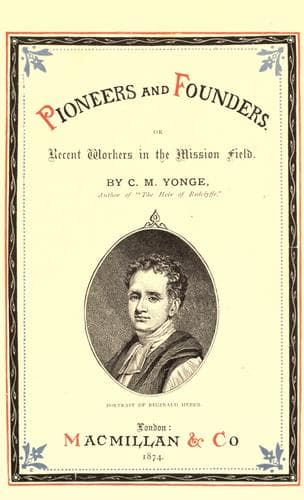
Pioneers and Founders: or, Recent Workers in the Mission fieldYonge, Charlotte M. (Charlotte Mary)
History
Pioneers and Founders: or, Recent Workers in the Mission field
Yonge, Charlotte M. (Charlotte Mary)
Missionaries
Strangely enough, his last text in preaching to the Samoans was,
"Sorrowing most of all for the words which he spake, that they should see
his face no more;" and the people, who always grieved whenever he left
them, wept as bitterly at the words as if they had known them to be an
omen. He was bent on an attempt on the heathen isle of Erromango, which
his wife viewed with a foreboding terror, that made her in vain try to
extract a promise from him not to land there.
But he viewed the New Hebrides as an important link, leading perhaps to
reaching the Papuan race in New Guinea. He hoped to gain a footing
there, and make the spot such a centre as Tahiti, Raiatea, Rarotonga, and
Samoa had successively been; and, as the _Camden_ glided along the shores
of the island, he talked of his schemes, and of a certain sense of fear
that they gave him, lest they were too vast to be accomplished by his
means and in his lifetime, but with the sanguine buoyancy of a man still
in full vigour, and who had met with almost unmixed success.
On the 20th of November, 1839, the vessel entered Dillon's Bay, and a
canoe with three men paddled up to her. A boat was lowered, in which Mr.
Williams, two other missionaries named Harris and Cunningham, Captain
Morgan, and four sailors seated themselves. They tried to converse with
the natives, but the language proved to be unlike any in use in Polynesia
(it is, in fact, one of the Melanesian dialects), and not a word could be
made out.
Pulling into a creek, some beads and a small looking-glass were thrown to
the natives, and water asked for by signs. It was brought, and this gave
more confidence. Harris then waded ashore. At first the people ran
away, but Mr. Williams called to him to sit down, and, on his doing so,
they came nearer, and offered him some cocoa-nut milk. Mr. Williams
observed little boys at play, and thought it a good sign. Captain Morgan
wished they had been women, because the natives always send their wives
out of the way when they mean violence. However, Williams landed, and
divided some cloth among those who stood nearest. Then Harris began to
walk forward into the bush, Williams following, and, with a crowd of
natives round him, was counting in Samoan, trying whether the boys around
would recognize the names of the figures. Cunningham did not like the
countenances of the natives, and remarked it to him, but was not heard.
Stooping to pick up a shell, Cunningham was startled by a yell, and
Harris came rushing along, pursued by a native. Williams turned and
looked, a blast on a shell was heard, and he too fled. Cunningham
reached the boat in safety, but Harris fell in crossing a small brook,
and the natives were at once upon him with their clubs. Williams had
made for the sea, apparently intending to swim off and let the boat pick
him up, but the beach was stony; he fell as he reached the water, and the
natives with their clubs and arrows had fallen upon him before Morgan
Public-domain text, read in full here on John Shaqi.
Reviews
Reviews
No reviews yet
Be the first to share your thoughts on this work.
Elsewhere in the archive
Join the Discussion
Join the discussion
Sign in to leave a comment or review.
Sign InorCreate an account