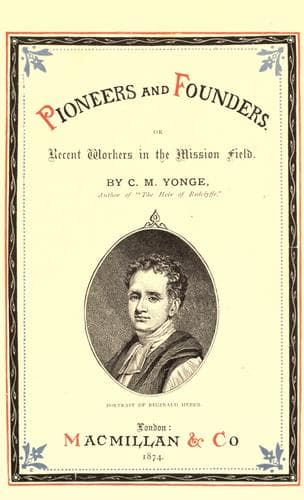
Pioneers and Founders: or, Recent Workers in the Mission fieldYonge, Charlotte M. (Charlotte Mary)
History
Pioneers and Founders: or, Recent Workers in the Mission field
Yonge, Charlotte M. (Charlotte Mary)
Missionaries
It was when his thoughts were directed to religious subjects, and his
intelligence freshly excited, that he visited the coasts of South
America, the region above all others where the Roman Catholic Church is
seen to the most disadvantage. Two things most especially struck him,
the remnants of the Inquisition at Lima, and the discovery that the poor
were buried without prayer or mass. Such scenes as these gave him an
extreme horror of Romanism and all that he supposed to be connected
therewith, and his next station at Tahiti, in all the freshness of the
newly established mission, full of devout people, filled him with strong
enthusiasm for the good men who were carrying out the work. Shortly
after he was invalided home, and as soon as he was fit for employment he
offered himself to the London Missionary Society, begging them to send
him to the neglected Indians of South America; but this did not suit
their plans, and his ardour was slackened by the more common affairs of
life. He fell in love and married a young lady named Julia Reade, and
his only voyage was in his naval, not his missionary capacity. But his
wife's health was exceedingly frail, and after eleven years of marriage
she died, leaving four children, a fifth having preceded her to the
grave. Beside her death-bed Allen Gardiner made a solemn dedication of
himself to act as a pioneer in one or other of the most neglected parts
of the earth, not so much to establish missions himself as to reconnoitre
the ground and prepare the way for their establishment.
Africa was the country to which his attention was first called. His wife
died in May 1834, and the 24th of August was the last Sunday he spent in
England, at Calbourne, the native parish of Charles Simeon. He sailed at
once for Cape Colony, where the English, who had in the course of the
Revolutionary war obtained possession of the ground from the original
settlers, the Dutch, were making progress in every direction, and coming
into collision, not with the spiritless Hottentots of the Cape of Good
Hope itself, but with that far more spirited and intellectual race, the
Kaffirs--unbelievers, as the name meant--they being in fact of Arab
descent, though Africanized by their transition through tropical
latitudes, and not Mahometans. Such traditional religion as they
possessed seemed to be vanishing, since only a few of the elders retained
a curious legend of a supreme Deity who sent another Divine being to
"publish the news," and divide the sexes. A message was sent to him from
the Power in heaven to announce that man should not die, but this was
committed to that tardy reptile the chameleon; then another message that
man should die was given to the lizard, who outran the chameleon, and
thus brought death into the world.
Public-domain text, read in full here on John Shaqi.
Reviews
Reviews
No reviews yet
Be the first to share your thoughts on this work.
Elsewhere in the archive
Join the Discussion
Join the discussion
Sign in to leave a comment or review.
Sign InorCreate an account