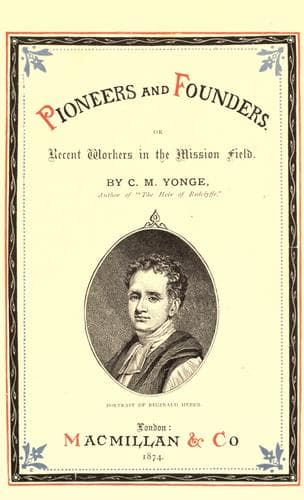
Pioneers and Founders: or, Recent Workers in the Mission fieldYonge, Charlotte M. (Charlotte Mary)
History
Pioneers and Founders: or, Recent Workers in the Mission field
Yonge, Charlotte M. (Charlotte Mary)
Missionaries
From the first he had one of those pure and stainless natures that seem
to be good without effort, but his talents were only considered
remarkable for arithmetic. His elder brothers used to set him up on a
table and try to puzzle him with questions, which he could often answer
mentally before they had worked them out on their slates. His father
died in 1830, after so much invalidism and separation that his five-year-
old boy had no personal recollection of him. The eldest son, Mr. Forbes
Mackenzie, succeeded to the estate of Portmore, and the rest of the
family resided in Edinburgh for education. Charles attended the Academy
till he was fifteen, when he was sent to the Grange School at Bishop's
Wearmouth, all along showing a predominant taste for mathematics, which
he would study for his own amusement and assist his elder brothers in.
His perfect modesty prevented them from ever feeling hurt by his
superiority in this branch, and he held his place well in classics,
though they were not the same delight to him, and were studied rather as
a duty and as a step to the ministry of the Church, the desire of his
heart from the first. At school, his companions respected him heartily,
and loved him for his unselfish kindness and sweetness, while a few of
the more graceless were inclined to brand him as soft or slow, because he
never consented to join in anything blameable, and was not devoted to
boyish sports, though at times he would join in them with great vigour,
and was always perfectly fearless.
From the Grange he passed to Cambridge, and was entered at St. John's,
but finding that his Scottish birth was a disadvantage according to
restrictions now removed, he transferred himself to Caius College. He
kept up a constant correspondence with his eldest sister, Mrs. Dundas,
and from it may be gathered much of his inner life, while outwardly he
was working steadily on, as a very able and studious undergraduate. With
hopes of the ministry before his eyes, he begged one of the parochial
clergy to give him work that would serve as training, and accordingly he
was requested to read and pray with a set of old people living in an
asylum. The effort cost his bashfulness much, but he persevered, with
the sense that if he did not go "no one else would," and that his
attempts were "better than nothing." This was the key to all his life.
At the same time he felt, what biography shows many another to have done,
the influence of the more constant and complete worship then enjoined by
college rules. Daily service was new to him, and was accepted of course
as college discipline, but after a time it gathered force and power over
his mind, and as the _Magnificat_ had been a revelation to Henry Martyn,
so Charles Mackenzie's affection first fixed upon the General
Thanksgiving, and on the commemoration of the departed in the prayer for
the Church Militant.
Public-domain text, read in full here on John Shaqi.
Reviews
Reviews
No reviews yet
Be the first to share your thoughts on this work.
Elsewhere in the archive
Join the Discussion
Join the discussion
Sign in to leave a comment or review.
Sign InorCreate an account