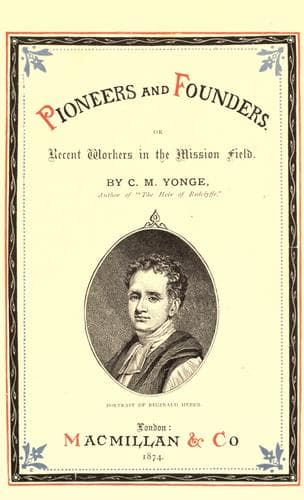
Pioneers and Founders: or, Recent Workers in the Mission fieldYonge, Charlotte M. (Charlotte Mary)
History
Pioneers and Founders: or, Recent Workers in the Mission field
Yonge, Charlotte M. (Charlotte Mary)
Missionaries
Mrs. Woodrow at once opened an orphanage for the destitute English
children that are sure to be found in a new colony, where the parents, if
unsuccessful, are soon tempted to drink, and then fall victims to climate
and accident. The Kaffir servant whom she engaged had already been
converted, and was baptized by the name of Abraham, soon after he entered
her service; but "Boy,"--the name at first given to him,--became a sort
of surname to him and to his family. While watching over the little band
of children, Mrs. Woodrow was already--even though as yet only learning
the language--preparing the way for the coming Church. She wrote of the
Kaffirs: "They come to me of all ages, men and women, some old men from
the country, with their rings upon their heads, and wrapped in their
house blankets. Then they sit down on the kitchen floor, our 'Boy'
telling them, in his earnest way, about JESUS CHRIST. These I cannot
speak to, but I manage to let them know that I care for them, and 'Boy'
says they go away with 'tears in their hearts.'"
About two years previously, a Scottish colonist at the Cape, named Robert
Robertson, had been touched by the need of ministers; had been ordained
by the Bishop of Capetown, and sent to Natal as missionary clergyman to
the Zulus. Early in 1855 these two devoted workers were married, and,
taking up their abode at Durban, continued together their care of the
English orphans, and of the Kaffir children whom they could collect.
In the meantime, Bishop Colenso, having taken his survey of the colony,
had returned to England to collect his staff of fellow-workers; and one
of his first requests was that Charles Mackenzie would accompany him as
Archdeacon of Pieter Maritzburg. There was not such entire willingness
in Mrs. Dundas's mind to part with him on this mission as on the former
proposal; not that she wished to hold him back from the task to which he
had in a manner dedicated himself, but she preferred his going out
without the title of a dignitary, and, from the tone of the new Bishop's
letters, she foresaw that doctrinal difficulties and differences might
arise.
Her brother had, however, made up his mind that no great work would ever
be done, if those who co-operated were too minute in seeking for perfect
accordance of opinions; and that boundless charity which was his great
characteristic made him perhaps underrate the importance of the fissure
which his sister even then perceived between the ways of thinking of
himself and his Bishop. His next sister, Anne, whose health was too
delicate for a northern climate, was to accompany him; and the entire
party who went out with Bishop Colenso numbered thirty or forty persons,
including several ladies, who were to devote themselves to education,
both of the white and black inhabitants. They sailed in the barque _Jane
Morice_ early in the March of 1855, and, after a pleasant and prosperous
voyage, entered Durban Bay in the ensuing May.
Public-domain text, read in full here on John Shaqi.
Reviews
Reviews
No reviews yet
Be the first to share your thoughts on this work.
Elsewhere in the archive
Join the Discussion
Join the discussion
Sign in to leave a comment or review.
Sign InorCreate an account