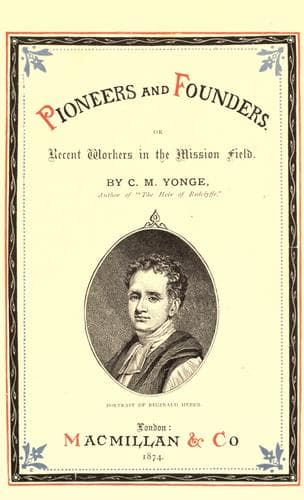
Pioneers and Founders: or, Recent Workers in the Mission fieldYonge, Charlotte M. (Charlotte Mary)
History
Pioneers and Founders: or, Recent Workers in the Mission field
Yonge, Charlotte M. (Charlotte Mary)
Missionaries
At six o'clock in the morning a large bell was rung. At eight, Kaffir
prayers were read by Mr. Robertson, for his own servants, in the
verandah, and for some who would come in from the neighbouring kraals;
then followed breakfast; then English matins; and, by that time, Kaffir
children were creeping up to the verandah to be taught. They were first
washed, and then taught their letters, with some hymns translated into
their language, and a little religious instruction. The children were
generally particularly pleasant to deal with, bright and intelligent, and
with a natural amiability of disposition that rendered quarrels and
jealousies rare. Good temper seems, indeed, to be quite a Zulu
characteristic; the large mixed families of the numerous wives live
together harmoniously, and the gift of a kraal to one member is
acknowledged by all the rest. Revenge, violence, and passion are to be
found among them, but not fretfulness and quarrelsomeness.
After the work of instruction, there was generally a ride into the
neighbouring kraals, to converse with the people, and invite the children
to school. They had to be propitiated with packets of sugar, and shown
the happy faces of the home flock. There was, at first, a good deal of
inclination to distrust; and the endeavour to bring the women and girls
to wear clothes had to be most cautiously managed, as a little over-haste
would make them take fright and desert altogether.
The Kaffir customs of marriage proved one of the most serious impediments
in the way of the missionaries. The female sex had its value as
furnishing servants and cultivators of the ground, and every man wished
to own as many wives as possible. Not only did the question what was to
be done in the case of many-wived converts come under consideration, but
the fathers objected to their daughters acquiring the rudiments of
civilization, lest it should lessen their capabilities to act as beasts
of burden, and thus spoil their price in cattle, (the true _pecunia_ of
the Zulu). Practically, it was found, that no polygamist ever became
more than an inquirer; the way of life seemed to harden the heart or
blind the eyes against conviction; but the difficulty as regarded the
younger people was great, since as long as a girl remained the lawful
property of the head of her kraal, she was liable to be sold to any
polygamist of any age who might pay her value; and thus it became a
question whether it were safe to baptize her. Even Christian Zulus
marrying Christian women according to the English rite could not be
secure of them unless the cows were duly paid over; and as these Kaffirs
are a really fine race, with more of the elements of true love in them
than is usual in savages, adventures fit for a novel would sometimes
occur, when maidens came flying to the mission station to avoid some old
husband who had made large offers to their father; and the real lover
would arrive entreating protection for the lady of his heart until he
Public-domain text, read in full here on John Shaqi.
Reviews
Reviews
No reviews yet
Be the first to share your thoughts on this work.
Elsewhere in the archive
Join the Discussion
Join the discussion
Sign in to leave a comment or review.
Sign InorCreate an account