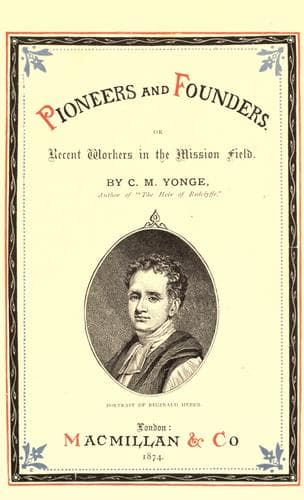
Pioneers and Founders: or, Recent Workers in the Mission fieldYonge, Charlotte M. (Charlotte Mary)
History
Pioneers and Founders: or, Recent Workers in the Mission field
Yonge, Charlotte M. (Charlotte Mary)
Missionaries
The time of the return of the brother and sister was just when Dr.
Livingstone's account of the interior of Africa, and of the character of
the chiefs on the Zambesi, had excited an immense enthusiasm throughout
England. He had appealed to the Universities to found a mission, and
found it they would, on a truly grand scale, commensurate with their
wealth and numbers. It was to have a Bishop at the head, and a strong
staff of clergy, vessels built on purpose to navigate the rivers, and
every requisite amply provided. Crowded meetings were held at each
University, and the enthusiasm produced by the appeal of Dr. Livingstone,
a Scottish Presbyterian, to the English Universities, as the only bodies
capable of such an effort, produced unspeakable excitement. At a huge
meeting at Cambridge, attended by the most distinguished of English
Churchmen, Archdeacon Mackenzie was present. His quiet remark to the
friend beside him, was, "I am _afraid_ of this. Most great works have
been carried on by one or two men in a quieter way, and have had a more
humble beginning." In fact, Bishop Gray, of Capetown, had long been
thinking of a Central African Mission; but his plan, and that which
Mackenzie would have preferred, was to work gradually northwards from the
places already Christian, or partially so, instead of commencing an
isolated station at so great a distance, not only from all aid to the
workers, but from all example or mode of bringing civilized life to the
pupils. But Livingstone had so thoroughly won the sympathies of the
country that only the exact plan which he advocated could obtain favour,
and it was therefore felt that it was better to accept and co-operate
with his spirit than to give any check, or divide the flow by contrary
suggestions.
Thus Livingstone became almost as much the guide and referee of the
Zambesi expedition as ever a Cardinal Legate was of a crusade. Nor could
this be wondered at, for the ordinary Englishman is generally almost
ignorant of missions and their history, and in this case an able and
interesting book of travels had stirred the mind of the nation; nor had
experience then shown how much more there was of the explorer than of the
missionary in the writer.
From the first, Archdeacon Mackenzie was designated as the chief of the
mission. He felt the appointment a call not to be rejected. His sister
Anne viewed it in the same spirit, and was ready to cast in her lot with
him, and letters were written to the other sister in Natal proposing to
her to accompany them. Then came a year of constant travelling and
oratory in churches and on platforms, collecting means and rousing
interest in the mission--a year that would have been a mere whirl to any
one not possessed of the wonderful calmness and simplicity that
characterized Mackenzie, and made him just do the work that came to hand
in the best manner in his power, without question or choice as to what
that work might be.
Public-domain text, read in full here on John Shaqi.
Reviews
Reviews
No reviews yet
Be the first to share your thoughts on this work.
Elsewhere in the archive
Join the Discussion
Join the discussion
Sign in to leave a comment or review.
Sign InorCreate an account