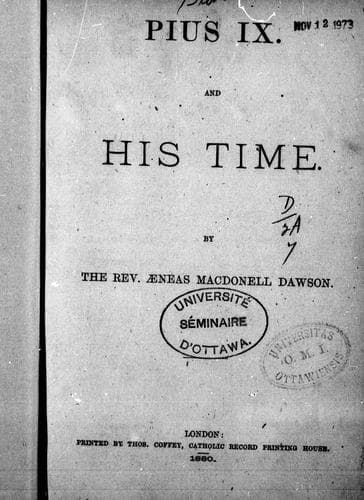
The great success of William I. in the Franco-Prussian war appears to have
so elated that monarch that he considered there was nothing which he might
not successfully undertake. He had annexed to Prussia some of the lesser
States of Germany, and made a German Empire. The Church in Germany enjoyed
many privileges and immunities under his predecessors, who, for the most
part, were, like himself, Protestants. Whether it was that he desired to
show himself a better Protestant than his ancestors, or that he could not
emancipate himself from the control of the minister who had so long
guided, with singular success, the destinies of the empire, as well as his
own career, or that he believed it to be a political necessity to act
according to the views and carry out the principles of the German and
European “Liberals”—the party of revolution and unbelief—he resolved to
oppose no impediment to his chancellor and the liberal majority of
parliament in their endeavors to destroy the Catholic Church in Germany,
unless it chose to become as a mere department of the State, acting and
speaking in the name of the State, receiving its appointments from the
State, as well as the funds requisite for the support of its ministers,
accepting all its orders and instructions, even in the most spiritual
things, from the State; in fine, looking to the State as the sole source
of all its authority, honor, power and influence. There was nothing like
the German Empire. It had conquered in gigantic wars with two Powers that
were considered the greatest in continental Europe. It had attained a
degree of power and greatness, scarcely if at all inferior to that of the
first Napoleon, and, like Napoleon, it aimed at more. It sought, like him,
to have the Church, no less than the police courts, in every respect, in
all circumstances and on all occasions, completely at its orders. This
ill-judged ambition accounts for the long list of oppressive laws which
were enacted at Berlin for the enslavement of the Catholic Church. They
are known as the “May Laws,” all of them having been passed, although not
in the same year, in the month of May. Dollinger, Hohenlohe and the rest
of the anti-Catholic Bavarian _coterie_, deluded the Emperor and his
minister with the idea of an independent German _alt_, or Old Catholic
Church. They sold their country to the new empire, politically. But they
could not sell its church. One of these _alt-Catholics_, Dr. Schulte,
recommended persecution as the surest means of eradicating the ancient
church. “Let his twenty thousand florins be withdrawn from such a one, his
twelve thousand thalers from such another; let the salaries of the bishops
and chapters be suppressed, and the result will soon be manifest. The
humbler clergy will rejoice. Since 18th July, 1870, there has been neither
belief in Christ nor religious conviction among the bearers of mitres and
tonsures.” Thus was the Prussian minister led to imagine that he had only
Public-domain text, read in full here on John Shaqi.
Reviews
Reviews
No reviews yet
Be the first to share your thoughts on this work.
Elsewhere in the archive
Join the Discussion
Join the discussion
Sign in to leave a comment or review.
Sign InorCreate an account