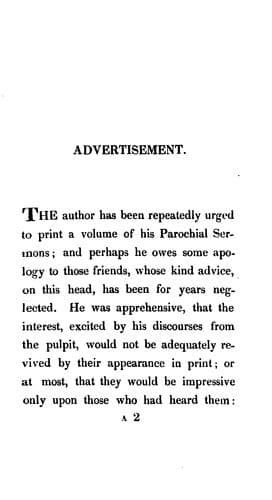
Plain Parochial Sermons, preached in the Parish Church of Bolton-le-MoorsSlade, James
Religion
Plain Parochial Sermons, preached in the Parish Church of Bolton-le-Moors
Slade, James
Episcopal Church -- Sermons; Sermons, English -- 19th century
And this conclusion corresponds with the experience of mankind in every
age: happiness has always been their object; philosophers have laid down
rules for its acquirement, and every variety of expedient has been tried;
but all in vain; there is no permanent pleasure or satisfaction upon
earth: independently of the crosses and vexations from without, by which
it is so continually disturbed, there is something in the constitution of
man, in the present state of his mind and heart and affections, by which
the attainment of happiness, from temporal means alone, is positively
forbidden.
The royal preacher, thus convinced of this truth, turns his thoughts to a
solution of the case, and sums up his observations, on the conduct and
condition of man, in the words of the text. Instead of arraigning, like
some bold and impious cavillers of our day, the wisdom or goodness of the
Creator in the introduction of evil into the world, he gives the true
account of the matter; and lays the blame where alone it is due, upon the
disobedience and degeneracy of man. And in so doing, he bears testimony
to the truth of one of the most important communications made to us in
the revealed word of God—the original innocence and the fall of our first
parents. This fact has been daringly called in question by certain
professed believers of divine revelation, by some who boast themselves
peculiarly entitled to the christian name. Anxious to exalt the moral
excellency of human nature, and to disprove the doctrine and necessity of
the atonement, through the prevailing efficacy of the Saviour’s
incarnation and sufferings, such vain disputers absolutely deny, in the
very face of God’s word, that any such total and dreadful change has ever
taken place in the state of mankind; they contend, that our
understandings and affections are now the same, as when we came
originally from the hands of our Creator. It appears, however, that the
_wisest_ of men took a different view of this momentous subject; that he
received the Mosaic account, recorded in the opening of the book of
Genesis, according to its plain and natural interpretation; and he has
delivered to us his judgment, by the inspiration of that Holy Spirit,
under whose guidance it was impossible for him to err.
Public-domain text, read in full here on John Shaqi.
Reviews
Reviews
No reviews yet
Be the first to share your thoughts on this work.
Elsewhere in the archive
Join the Discussion
Join the discussion
Sign in to leave a comment or review.
Sign InorCreate an account