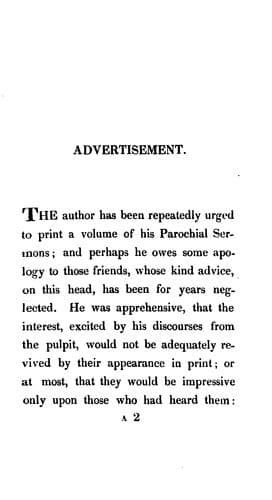
Plain Parochial Sermons, preached in the Parish Church of Bolton-le-MoorsSlade, James
Religion
Plain Parochial Sermons, preached in the Parish Church of Bolton-le-Moors
Slade, James
Episcopal Church -- Sermons; Sermons, English -- 19th century
FROM this, and one or two other passages in the gospels, it has been
sometimes imagined, that our blessed Lord set no value on the common
relationships, the natural ties, the tender endearments of life; and that
He intended to teach His disciples, by His own example, to neglect such
considerations altogether; as if all Christians had an equal claim upon
our affection; as if the spiritual brotherhood were the only object
worthy of our regard; as if parents and brothers and sisters were merely
upon a footing with the rest of mankind. This notion is entirely
erroneous; it is a mistaken conclusion from the words and conduct of our
Lord.
His own example, on several occasions, has afforded a sanction to the
feelings of private friendship, as well as of family affection. How
deeply was He moved at the death of Lazarus! “Jesus wept, then said the
Jews, behold how He loved him!” {367a} And of our Lord’s disciples we
read, that there was one, treated with peculiar tenderness and regard;
one, “who leaned on His bosom;” {367b} one, distinguished by the high and
honourable name of the “beloved disciple.” And this disciple, the
evangelist St. John, has drawn one of the most striking pictures of an
affectionate family, ever represented to the eye and the heart of man:
“There stood by the cross of Jesus, His mother, and His mother’s sister,
Mary the wife of Cleophas, and Mary Magdalene. When Jesus therefore saw
His mother, and the disciple standing by whom He loved, He saith unto His
mother, Woman, behold thy son! Then saith He to the disciple, Behold thy
mother! And from that hour that disciple took her unto his own home.”
Jesus not only loved and protected His mother through life, but was
solicitous to provide for her future well-being, even amidst the agonies
of the cross; commending her to His dearest personal friend; and by way
of effectually securing _his_ regard and _her_ confidence, He calls John
the son, and Mary the mother: Behave to each other as mother and son; and
it is all I can ask or require. This must be admitted as a proof, that
Jesus felt most tenderly and peculiarly for His nearest earthly relation:
and it shews, that those passages, which have been supposed to favour a
contrary opinion, have been wrongly interpreted.
Public-domain text, read in full here on John Shaqi.
Reviews
Reviews
No reviews yet
Be the first to share your thoughts on this work.
Elsewhere in the archive
Join the Discussion
Join the discussion
Sign in to leave a comment or review.
Sign InorCreate an account