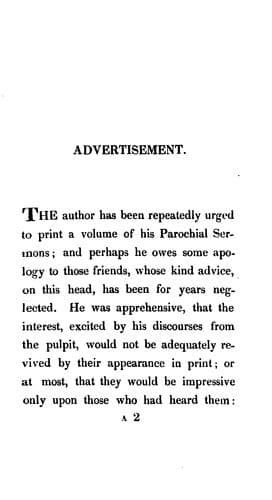
Plain Parochial Sermons, preached in the Parish Church of Bolton-le-MoorsSlade, James
Religion
Plain Parochial Sermons, preached in the Parish Church of Bolton-le-Moors
Slade, James
Episcopal Church -- Sermons; Sermons, English -- 19th century
And this, the design of a merciful Providence, which is manifest to our
common reason and our common feelings, is abundantly verified and
enforced by the holy word of God. The fifth commandment in the law
distinctly recognizes and requires the exercise of domestic affection;
and it is repeatedly confirmed, under the gospel covenant, by the pen of
an inspired apostle. That apostle has farther declared, that “if any
provide not for his own, and specially for those of his own house, he
hath denied the faith, and is worse than an infidel.” {379} And the
sense of this precept may be properly extended, to sanction and command
all those peculiar offices, of kindness and countenance and support,
which the members of a family can perform for each other. Under ordinary
circumstances therefore, if there be no opposing necessity, the natural
tie is to be respected by the Christian, and bound upon his conscience
and his heart.
Nor is such a connexion to be dissolved, but in cases of extremity; for
this among other reasons, that there is always a hope, of the recreant
and abandoned becoming, by the mercy of God, at length reclaimed and
converted; and of this great blessing the pious relative may be made an
instrument, by his fervent prayer, his affectionate counsel, and the
constant influence of his good example.
But all this hinders us not from looking, with a very different eye, upon
the spiritual and the worldly relation; upon the good and the evil;
though both may be objects of our kind personal offices, the nature and
degree of our affection may vary most exceedingly. Our love for the
truly christian relative has a fervour, a purity, a delight, which
nothing but the mutual working and spirit of religion can possibly
generate: the happiness proceeds from that sacred, heavenly source, from
which both of us draw our principles and hopes; from the consciousness of
our common interest in the great Redeemer, and our common relationship to
Him: we are both “members of Christ and children of God;” inheritors of a
better kingdom; to which we are journeying together, and of which we love
to be discoursing; it is a bond of union, which nothing can separate; not
distance, not death: for this is the great consideration, the great
enhancement of our joy and comfort, that the love which we are bearing
for one another, in the kingdom of grace, shall be renewed and matured in
the kingdom of glory. And unless there be this principle of attachment
between relations, this common faith and hope, this exercise of piety and
godliness, this interchange of holy affection, all other attachments,
however requisite for this world, are but time-serving and poor: death
will be the dreadful extinction. But when the natural affection is thus
combined with the spiritual, and draws its nourishment from it, they
produce together a happiness, which none but such relations can know.
Public-domain text, read in full here on John Shaqi.
Reviews
Reviews
No reviews yet
Be the first to share your thoughts on this work.
Elsewhere in the archive
Join the Discussion
Join the discussion
Sign in to leave a comment or review.
Sign InorCreate an account