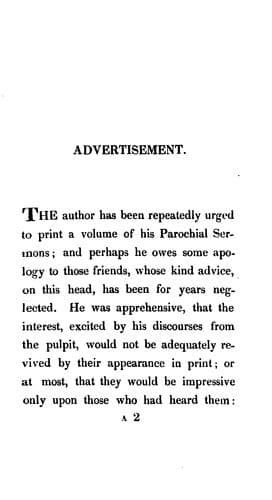
Plain Parochial Sermons, preached in the Parish Church of Bolton-le-MoorsSlade, James
Religion
Plain Parochial Sermons, preached in the Parish Church of Bolton-le-Moors
Slade, James
Episcopal Church -- Sermons; Sermons, English -- 19th century
St. Paul says, “I press toward the mark;” alluding to the mark, or line,
drawn across the end of the course, to shew where it terminated. The end
of our course is death; that is the mark, to which we must constantly
press; never, till we reach it, can our striving be over, can the victory
be gained. If we perceive ourselves languishing or weary, if the enemy
of our souls would tempt us, as he undoubtedly will do, to indolence or
repose, let us instantly pray to our Almighty Father, for a double
portion of His Holy Spirit, and he will enable us to renew our vigour,
and maintain our stedfastness. Yea, though the race be so protracted,
that our limbs may be growing feeble with age, and our vital energies
decaying, still we shall be inspirited with a courage and strength, that
will be found abundantly sufficient; and as we near the end, our hopes
will rise, and our prospect will brighten; the weakness of nature will be
assisted and compensated by a merciful increase of faith; and we shall
press onward, through the latter part of the trial, with holier
confidence and fuller expectation.
And all this, “for the prize of our high calling in Christ Jesus.” What
was it, that led the people of former days, to enter into the list, and
engage in the race? Why were they content to undergo such previous
hardships and privations, in order to qualify them for the task? Why did
they exert themselves in the contest, so laboriously and painfully, as if
willing to sacrifice their lives in the struggle? It was for a little
crown of withering leaves; for the honour of their countrymen’s applause;
and the approval of their families and friends. How then do they put to
shame the negligent and indifferent christian; him that refuses to train
and labour for the conflict of life, for the cause of salvation! What is
our prize? what are our objects? “an incorruptible crown,” a “crown of
glory that fadeth not away;” an eternal inheritance in the heavens; the
approbation of all good men; the welcome acclaim of a “multitude of
angels which no man can number;” the approval, the everlasting reward of
the Judge of our christian race. Are not these objects worthy of our
supreme regard? Is not this worth contending for? Does it not demand
all our attention, all our anxiety, all our watchfulness and diligence
and labour? Should not our whole soul be devoted thereto? Ought it not
to be, comparatively speaking, the sole purpose, for which we care to
live and hope to die?
Public-domain text, read in full here on John Shaqi.
Reviews
Reviews
No reviews yet
Be the first to share your thoughts on this work.
Elsewhere in the archive
Join the Discussion
Join the discussion
Sign in to leave a comment or review.
Sign InorCreate an account