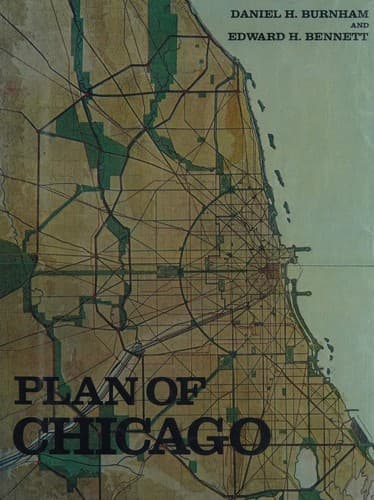
City planning -- Illinois -- Chicago -- History -- 20th century
In the plan here presented, the surface of the elevated boulevard
connection at Lake Street would be only 11 feet higher than the present
Michigan Avenue, and the upper deck of the new bridge would be only 16
feet higher than the surface of the present Rush Street bridge, and
only 9¼ feet higher than the surface of the Jackson Boulevard bridge.
Looking south, a pedestrian would see before him Grant Park and the
improved Michigan Avenue; the view along the river, both east and
west, would offer an interesting picture of the business activities of
the city; on the north the wide avenue would end at the water-tower,
beyond which can be seen the waters of Lake Michigan opposite the
Lake Shore Drive. Thus the plan presents one of the most magnificent
highways of the world. It seizes and develops the finest opportunity
which Chicago possesses for this purpose. The people of Chicago, during
the past twenty-five years, have expended more than $220,000,000 in
permanent improvements. This fact proves conclusively that the city
is bent on increasing its traffic facilities; yet because there has
been no comprehensive plan for development of city thoroughfares, much
of this work must now be done over again. The proposed connecting
boulevard is but one detail in the plan of a great city, but it is one
of the most important. Unless the Lake front is dealt with as one great
thoroughfare, there is no excuse for the expenditure of a large sum of
money on a single span of it.
This great improvement will come because it is a part of a plan which
provides a basis of street circulation, and which will weld and unify
the three detached sides of Chicago; because it will improve facilities
for commercial traffic, and at the same time preserve for the people
the uninterrupted use of their greatest and most attractive highway.
[Illustration: CXIX. CHICAGO. SKETCH PLAN OF THE INTERSECTION OF
MICHIGAN AVENUE AND TWELFTH STREET.
COPYRIGHT, 1909, BY COMMERCIAL CLUB OF CHICAGO]
No less important than the widening and extension of Michigan Avenue is
the improvement of Halsted Street, often called “the king of streets”
by reason of its extreme length. This street begins near the Lake,
two and a half miles north of Lincoln Park, and thence runs directly
south through the center of population of Chicago to the southern city
limits and beyond them to Chicago Heights, a distance in the city of
over twenty miles. This street will inevitably be called upon to bear
a very heavy burden of traffic. One of the longest business streets
in the world, it is bound to become also one of the most important.
The necessity for widening Halsted Street becomes apparent when one
considers that this thoroughfare, situated midway between Michigan and
Ashland avenues, is already congested by reason of the traffic poured
into it by those important diagonals, Milwaukee Avenue on the northwest
and Blue Island Avenue on the southwest.
Public-domain text, read in full here on John Shaqi.
Reviews
Reviews
No reviews yet
Be the first to share your thoughts on this work.
Elsewhere in the archive
Join the Discussion
Join the discussion
Sign in to leave a comment or review.
Sign InorCreate an account