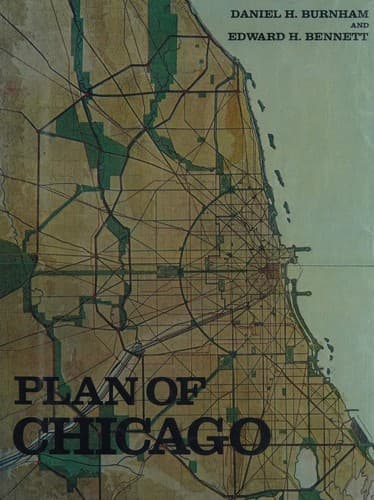
City planning -- Illinois -- Chicago -- History -- 20th century
It is fully realized that a plan calling for improvements on a scale
larger and more inclusive than any heretofore proposed seems, on first
consideration, beyond the financial ability of the community. If,
however, the plan meets public approval, it can be executed without
seriously increasing present burdens. The very growth of the city,
creating as it does wealth greater than mines can produce, gives a
basis of bond issues in excess of the utmost cost involved in carrying
out this plan. The increase in the assessed value of real estate in the
city of Chicago for the past ten years exceeds the expense required to
put the plan into execution; and at the same time the very character of
the proposed changes is such as to stimulate the increase in wealth.
The public, therefore, has the power to put the plan into effect if it
shall determine to do so.
It is quite possible that some revision of existing laws may be
necessary in order to enable the people to carry out this project;
but this is clearly within the power of the people themselves. The
realization of the plan, therefore, depends entirely on the strength
of the public sentiment in its favor. And what hope is there that the
people will desire to make Chicago an ideal city? A brief survey of the
past will help to form an opinion on this subject.
Sixty years ago, when Chicago was scarcely more than a village, it
became apparent that in order to secure proper drainage the street
levels must be raised to a considerable extent throughout what we
know as the old city, from the main river to Twelfth Street, and also
for a distance on the West and North Sides. This project, albeit a
very formidable one for that time, was promptly entered upon and
duly carried out, although it involved raising all the streets and
most of the buildings throughout that large territory. For that
day and generation the undertaking was much more serious than the
reconstruction of the city thoroughfares now proposed.
Again, some fifty years ago, when the idea of creating great
metropolitan park areas was new, Chicago undertook to acquire and
improve a chain of parks surrounding the city on three sides. This
scheme, which has well supplied the needs of Chicago until recent
times, was carried out in such a manner that it never was burdensome.
The creation of a park system for Chicago was not undertaken from
motives of utility, but purely because of a desire to make the city
attractive; and the success was magnificent.
Later, in the Eighties, the purification of the water of Lake Michigan
by the diversion of the sewage became a public issue. Once again the
people of Chicago rose to the occasion; and after years of hard work
the Drainage Canal, built at a cost of $60,000,000, has been completed.
Public-domain text, read in full here on John Shaqi.
Reviews
Reviews
No reviews yet
Be the first to share your thoughts on this work.
Elsewhere in the archive
Join the Discussion
Join the discussion
Sign in to leave a comment or review.
Sign InorCreate an account