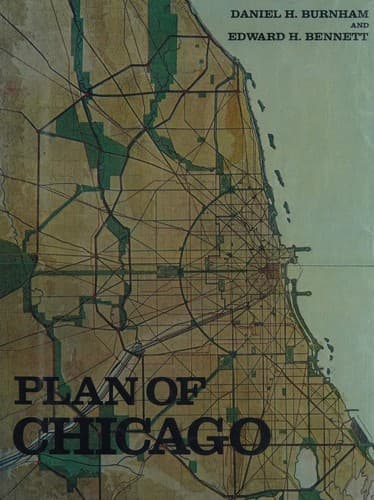
City planning -- Illinois -- Chicago -- History -- 20th century
The interurban highway system can be realized very cheaply. Ninety-five
per cent of the necessary roads now exist as public highways, and the
cost of acquiring the other five per cent will be merely nominal. The
diagram (Plate XL) is laid out with a radius of approximately sixty
miles from the city hall. The cost of widening that comparatively small
portion of the roadways which require to be widened; the straightening
of the few which need such treatment; the planting of trees along the
highways; and the macadamizing of the roads are improvements that may
be hastened by concerted intelligent action. The expense involved is
comparatively small, but the economy and convenience to the public are
very large. Is it not evident that this portion of the plan can be
realized at no distant day provided a strong organization of active men
shall be formed for the purpose of carrying it into effect?
The suggestions in regard to trunk lines, their rights-of-way,
stations, and general conditions, are many and serious. The suggestions
have been made for the purpose of bringing about the greatest economy
of money and time, both in freight and passenger handling. If the
recommendations herein contained will produce conditions really
beneficial to the individual shipper and passenger, undoubtedly they
will be found best for the railroads themselves. The direct object
in view is to free a large portion of the South Side from tracks and
stations and restore it to business use; to double the capacity of
the streets of the whole city by opening circulation to the north,
west, and south, and by connecting the outlying parts in the best
possible manner with the heart of the city. Over and above all these
considerations, highly important as they all are, is economy in the
freight handling of Chicago as a shipping center. The object here has
been to find that general principle which, if applied, will give to the
merchants, manufacturers, and jobbers of this city all the advantages
that should naturally be theirs throughout the great territory
dominated by Chicago. If the general scheme herein proposed shall not
be adopted by the public and the railroads, some other inevitably
must be, because the very life of the community is involved in the
solution of this problem. The commercial prosperity of the community
is represented by the cost per ton of handling freight into and out
of this territory as a shipping center. General changes in railroad
conditions take years to accomplish. That will be the case if such a
scheme as we recommend is carried out; but the public should remember
that they will not be taxed to pay for it. When these improvements come
they will be railroad enterprises, undertaken by the railroads and
carried out by the railroads.
Public-domain text, read in full here on John Shaqi.
Reviews
Reviews
No reviews yet
Be the first to share your thoughts on this work.
Elsewhere in the archive
Join the Discussion
Join the discussion
Sign in to leave a comment or review.
Sign InorCreate an account