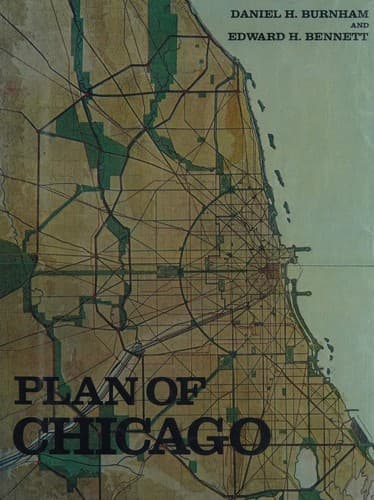
City planning -- Illinois -- Chicago -- History -- 20th century
Finally, it seems probable that the schemes of outer highways and of
all the Lake front improvements may come about quite naturally and with
very little expense to the city; that the railways will pay most of
the expense of their changes and improvements, thus leaving a portion
of the cost of the traction system and all of the cost of the civic
center, of the parks and parkways, and of the street development for
the general public to meet. The community has ample financial ability
to do its part without placing undue burdens upon the people. Paris
had not much more than half a million people, and her commercial
prospects were far less than are ours to-day, when that municipality
adopted a street improvement scheme involving over two hundred and
sixty million dollars, and carried it to completion in thirty-five
years. The motive of the French people in undertaking this enterprise
was to create a great attraction for all men: a city so delightful as
to insure continuous prosperity to the inhabitants. The success of
the undertaking has amply justified the pains and the expense. People
from all over the world visit and linger in Paris. No matter where
they make their money, they go there to spend it; and every proprietor
and workman in Paris benefits by reason of that fact. Conditions in
Chicago are such as to repel outsiders and drive away those who are
free to go. The cream of our own earnings should be spent here, while
the city should become a magnet, drawing to us those who wish to enjoy
life. The change would mean prosperity, effective, certain, and forever
continuous.
If, therefore, the plan is a good one, its adoption and realization
will produce for us conditions in which business enterprises can
be carried on with the utmost economy, and with the certainty of
successful issue, while we and our children can enjoy and improve life
as we cannot now do. Then our own people will become home-keepers, and
the stranger will seek our gates.
[Illustration: CXLII. THE GREAT LAKES.
From the group by Lorado Taft.]
LEGAL ASPECTS OF THE PLAN OF CHICAGO
The following opinion, prepared by WALTER L. FISHER, as counsel for the
Plan Committee of the Commercial Club, has been submitted to EDWARD J.
BRUNDAGE, Corporation Counsel for the City of Chicago, HARRY A. LEWIS,
County Attorney of Cook County, BENJAMIN F. RICHOLSON, Attorney for
the West Chicago Park Commissioners, CHARLES A. CHURAN, Attorney for
the Commissioners of Lincoln Park, ROBERT REDFIELD, Attorney for the
South Park Commissioners, to EDGAR B. TOLMAN, FRANK L. SHEPARD, HARRY
S. MECARTNEY, FRANK HAMLIN, and R. P. HOLLETT, who have been counsel
for these official bodies, respectively, and to MILTON J. FOREMAN,
Member of the City Council of Chicago, and GEORGE A. MASON, Special
Assessment Attorney for the City, all of whom concur in the conclusions
and recommendations stated. WILLIAM W. CASE assisted in the preparation
of the opinion.
Public-domain text, read in full here on John Shaqi.
Reviews
Reviews
No reviews yet
Be the first to share your thoughts on this work.
Elsewhere in the archive
Join the Discussion
Join the discussion
Sign in to leave a comment or review.
Sign InorCreate an account