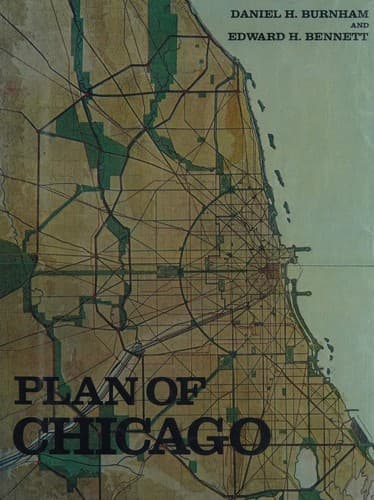
City planning -- Illinois -- Chicago -- History -- 20th century
In this country the owner, even if compensation were provided,
could demand the judgment of a court whether the use for which his
property was taken was a “public use,” within the judicial definition
of that phrase as found in our constitutions. In Illinois he could
insist upon his further constitutional privilege of having his
compensation fixed by a jury before the restriction became operative.
The public authorities of Paris, when condemning land for municipal
purposes, were authorized to and did take more extensive areas than
were actually needed, seeking by this means to recoup the cost of the
improvements by selling the adjacent premises at the enhanced values
produced by these improvements. Indeed, the contractors for these
public works were themselves authorized, in some cases, to acquire
considerable areas outside the lines of the actual improvement, so
that the prospective profits thus to be realized might be deducted
from the cost of the improvement to the public.[31] Governments in
this country are forbidden by constitutional principles thus to take
private property against the will of the owner merely for pecuniary
profit. Many cities in Great Britain and on the continent have removed
the entire population of insanitary districts and have constructed new
dwellings, at public expense, in the renovated area. Such features
figure largely in the town-planning schemes of Europe, but have been
considered inexpedient or unnecessary here. The town-planning bill
introduced in Parliament last year by John Burns not only confers power
upon municipal authorities to impose a town-planning scheme on any land
within or near their boundaries, but enables the authorities to take
judgment against the owners of neighboring property for the amount by
which its value is enhanced through the operation of the plan. Such
methods of procedure, however justifiable from an economic point of
view, would be contrary to established public policy in this country.
The constitution of Illinois requires uniformity of taxation with
respect to both persons and property, and while it permits the cost of
local improvements to be assessed by the authorities of cities, towns
and villages upon property specially benefited thereby, it not only
limits the aggregate amount of such special assessments to the cost of
the improvement, but requires the distribution of that aggregate over
all property similarly benefited.
Public-domain text, read in full here on John Shaqi.
Reviews
Reviews
No reviews yet
Be the first to share your thoughts on this work.
Elsewhere in the archive
Join the Discussion
Join the discussion
Sign in to leave a comment or review.
Sign InorCreate an account