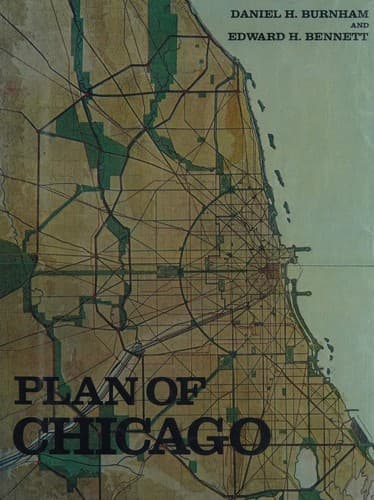
City planning -- Illinois -- Chicago -- History -- 20th century
needs of the growing city, 80;
adequate circulation and sufficient park area essential, 80;
cost of postponing improvements in circulation system, 81;
report on street paving, 83;
existing diagonals, 84;
location of the city, 89;
advantages of rectilinear street system, 89;
circular avenues, 90;
necessity for platting outlying district, 91;
preserving width of existing avenues, 92;
circuit arteries suggested, 92;
avenues paralleling railways, 94;
diversion of traffic from the business center, 95;
proposed circuits, 95-96;
encroachments on the river, 97;
treatment of river banks, 97, 112;
widening of streets, 97;
requisites for area outside the business center, 98;
the heart of Chicago, 99;
spread of population, 99;
disposition of traffic within the business center, 99;
Michigan Avenue the base line of the city, 100;
width of streets, 100;
bridge at Michigan Avenue, 105;
expenditures for permanent improvements, 107;
the improvement of Halsted Street, 107; slums of the city, 108;
Berlin an example for housing conditions, 109;
opportunity for comprehensive treatment of the central portion of
the city, 110;
development of Grant Park, 110;
economy and effectiveness of group-plan for Grant Park, 111;
a yacht harbor, 111;
gifts by citizens should be encouraged, 112;
Congress Street as the grand axis, 113;
reasons for choice of Congress Street for grand axis, 113, 114;
the civic center, 115;
buildings composing civic center, 115, 116;
dome of civic center, 116, 118;
Federal group of buildings, 117;
increase in real estate values, 119;
raising street levels, 120;
creation of the park system, 120;
purification of Lake Michigan, 120;
cost of World’s Fair, 120;
cultivation of the fine arts, 120;
influence of the universities, 120;
taxing powers, 153.
City-planning, begins in Paris, 13;
in Europe, 19;
French and German theories, 20.
Civic Center of Chicago, buildings comprising, 115;
location of, 115;
architecture of, 117;
dome of, 118;
cost of, 123;
power of park commissioners to acquire land for, 134.
Civil Law, unifying force of, 31.
Cleanliness, a necessity for the city, 82.
Cleveland, Ohio, group-plan for, 27;
cost of improvements in, 27.
Club houses for the people, 44.
Colbert, one of the Paris planners, 15, 20.
Commerce, governing motive in location of cities, 9;
beginning of in Europe, 13;
expansion of, 19;
makes art creations possible, 22.
Commercial Club, undertakes plan of Chicago, 1;
designs for Lake Front improvement presented to, 6;
consolidates with Merchants’ Club, 7;
carries on work for plan of Chicago, 7;
meetings of, 7;
discussion of good roads, 39 (note).
Condemnation, limitations on the right of, 128;
congested areas, power to open, 151.
Public-domain text, read in full here on John Shaqi.
Reviews
Reviews
No reviews yet
Be the first to share your thoughts on this work.
Elsewhere in the archive
Join the Discussion
Join the discussion
Sign in to leave a comment or review.
Sign InorCreate an account