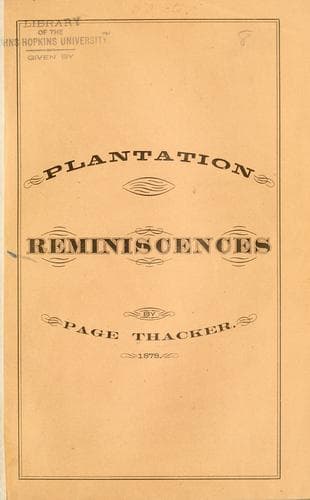
Plantation life; Virginia -- Social life and customs
His circumstances and surroundings were now changed--no longer the
stars and epaulets adorned his manly form; but dressed in a simple suit
of pure white linen, he looked a king, and adversity had wrought no
change in his character, manner, or conversation.
To reach our house he made a journey--on his old war horse,
"Traveler"--forty miles across the mountains, describing which, on the
night of his arrival, he said:
"To-day an incident occurred which gratified me more than anything that
has happened for a long time. As I was riding over the most desolate
mountain region, where not even a cabin could be seen, I was surprised
to find, on a sudden turn in the road, two little girls playing on a
large rock. They were very poorly clad, and after looking a moment at
me, began to run away. 'Children,' said I, 'don't run away. If you
could know _who_ I am, you would know that I am the last man in the
world for anybody to run from now.'
"'But we do know you,' they replied.
"'You never saw me before,' I said, 'for I never passed along here.'
"'But we do know you,' they said, 'And we've got your picture up yonder
in the house, and you are General Lee! And we ain't dressed clean
enough to see you.'
"With this they scampered off to a poor log hut on the mountain side."
It was gratifying to him to find that even in this lonely mountain hut
the children had been taught to know and revere him.
He told us, too, of a man he met the same day in a dense forest who
recognized him, and throwing up his hat in the air, said: "General,
_please_ let me cheer you," and fell to cheering with all his lungs!
* * * * *
My last recollections of General Lee, when making a visit of several
weeks at his house, the year before his death--although not coming
properly under the head of "plantation reminiscences"--may not be
inappropriate here.
It has been said that a man is never a "hero to his valet;" but this
could not have been said of General Lee, for those most intimately
connected with him could not fail to see continually in his bearing and
character something above the ordinary level, something of the hero.
At the time of my visit the commencement exercises of the College, of
which he was President, were going on. His duties were necessarily
onerous. Sitting up late at night with the board of visitors, and
attending to every detail with his conscientious particularity, there
was little time for him to rest. Yet every morning of that busy week
he was ready, with his prayer-book under his arm, when the church bell
called its members to sun-rise service.
It is pleasant to recall all he said at the breakfast, dinner and tea
table, where in his hospitality he always insisted upon bringing all
who chanced to be at his house at those hours--on business or on social
call.[8]
This habit kept his table filled with guests, who received from him
elegant courtesy.
Public-domain text, read in full here on John Shaqi.
Reviews
Reviews
No reviews yet
Be the first to share your thoughts on this work.
Elsewhere in the archive
Join the Discussion
Join the discussion
Sign in to leave a comment or review.
Sign InorCreate an account