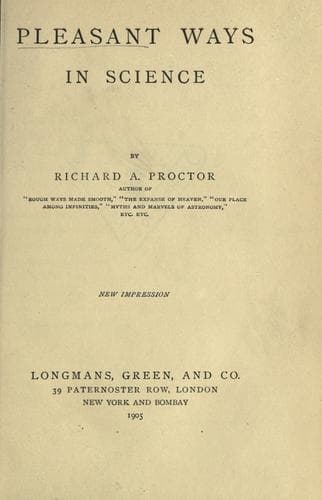
Pleasant Ways in ScienceProctor, Richard A. (Richard Anthony)
Science
Pleasant Ways in Science
Proctor, Richard A. (Richard Anthony)
Science
from us, then not only would it have the utterly monstrous dimensions
stated by Sir J. Herschel, but it would in the most effective way
perturb the whole solar system. With a diameter exceeding seven times
that of the orbit of Neptune, it would have a volume, and therefore a
mass, exceeding our sun’s volume and mass more than eleven millions
of millions of times. But its distance on this assumption would be
only about two hundred thousand times the sun’s, and its attraction
reduced, as compared with his, on this account only forty thousand
millions of times. So that its attraction on the sun and on the earth
would be greater than his attraction on the earth, in the same degree
that eleven millions are greater than forty thousand—or two hundred
and seventy-five times. The sun, despite his enormous distance from
such a mass, would be compelled to fall very quickly into it, unless
he circuited (with all his family) around it in about one-sixteenth of
a year, which most certainly he does not do. Nor would increasing the
distance at which we assume the star to lie have any effect to save
the sun from being thus perturbed, but the reverse. If we double for
instance our estimate of the nebula’s distance, we increase eightfold
our estimate of its mass, while we only diminish its attraction on
our sun fourfold on account of increased distance; so that now its
attraction on our sun would be one-fourth its former attraction
multiplied by eight, or twice our former estimate. We cannot suppose
the nebula to be much nearer than the nearest star. Again, we cannot
suppose that the light of these gaseous nebulæ comes from some bright
orb within them of only starlike apparent dimensions, for in that case
we should constantly recognize such starlike nucleus, which is not the
case. Moreover, the bright-line spectrum from one of these nebulæ comes
from the whole nebula, as is proved by the fact that if the slit of the
spectroscope be opened it becomes possible to see three spectroscopic
images of the nebula itself, not merely the three bright lines.
Public-domain text, read in full here on John Shaqi.
Reviews
Reviews
No reviews yet
Be the first to share your thoughts on this work.
Elsewhere in the archive
Join the Discussion
Join the discussion
Sign in to leave a comment or review.
Sign InorCreate an account