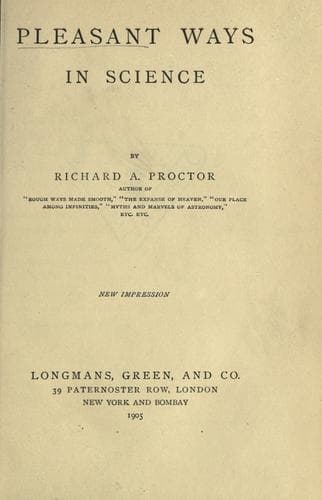
Pleasant Ways in ScienceProctor, Richard A. (Richard Anthony)
Science
Pleasant Ways in Science
Proctor, Richard A. (Richard Anthony)
Science
A case of this kind is to be met with in the stars forming the
constellation Taurus. It was here that Mädler recognized a community
of motion among the stars, but he did not interpret this as I do. He
had formed the idea that the whole of the sidereal system must be in
motion around some central point; and for reasons which need not here
be considered, he was led to believe that in whatever direction the
centre of motion may lie, the stars seen in that general direction
would exhibit a community of motion. Then, that he might not have to
examine the proper motions all over the heavens, he inquired in what
direction (in all probability) the centre of motion may be supposed
to lie. Coming to the conclusion that it must lie towards Taurus,
he examined the proper motions in that constellation, and found a
community of motion which led him to regard Alcyone, the chief star of
the Pleiades, as the centre around which the sidereal system is moving.
Had he examined further he would have found more marked instances of
community of motion in other parts of the heavens, a circumstance which
would have at once compelled him to abandon his hypothesis of a central
sun in the Pleiades, or at least to lay no stress on the evidence
derivable from the community of motion in Taurus.
Perhaps the most remarkable instance of star-drift is that observed in
the constellations Gemini and Cancer. Here the stars seem to set bodily
towards the neighbouring part of the Milky Way. The general drift
in that direction is too marked, and affects too many stars, to be
regarded as by any possibility referable to accidental coincidence.
It is worthy of note that if the community of star-drift should be
recognized (or I prefer to say, _when_ it is recognized), astronomers
will have the means of determining the relative distances of the
stars of a drifting system. For differences in the apparent direction
and amount of motion can be due but to differences of distance and
position, and the determination of these differences becomes merely a
question of perspective.[18]
Before long it is likely that the theory of star-drift will be
subjected to a crucial test, since spectroscopic analysis affords the
means of determining the stellar motions of recess or approach. The
task is a very difficult one, but astronomers have full confidence that
in the able hands of Mr. Huggins it will be successfully accomplished.
I await the result with full confidence that it will confirm my views.
(See pages 92–94 for the result.)
* * * * *
Turning to the subject of Star-mist, under which head I include all
orders of nebulæ, I propose to deal with but a small proportion of the
evidence I have collected to prove that none of the nebulæ are external
galaxies. That evidence has indeed become exceedingly voluminous.
I shall dwell, therefore, on three points only.
Public-domain text, read in full here on John Shaqi.
Reviews
Reviews
No reviews yet
Be the first to share your thoughts on this work.
Elsewhere in the archive
Join the Discussion
Join the discussion
Sign in to leave a comment or review.
Sign InorCreate an account