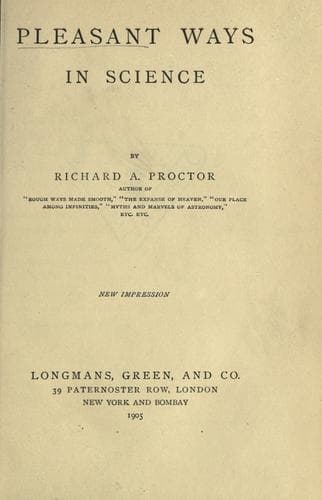
Pleasant Ways in ScienceProctor, Richard A. (Richard Anthony)
Science
Pleasant Ways in Science
Proctor, Richard A. (Richard Anthony)
Science
The Arctic Expedition which returned to our shores in the autumn of
1876 may be regarded as having finally decided the question whether
the North Pole of the earth is accessible by the route through Smith’s
Sound—a route which may conveniently and properly be called the
American route. Attacks may hereafter be made on the Polar fastness
from other directions; but it is exceedingly unlikely that this
country, at any rate, will again attempt to reach the Pole along
the line of attack followed by Captain Nares’s expedition. I may be
forgiven, perhaps, for regarding Arctic voyages made by the seamen
of other nations as less likely to be successful than those made by
my own countrymen. It is not mere national prejudice which suggests
this opinion. It is the simple fact that hitherto the most successful
approaches towards both the Northern and the Southern Poles have been
made by British sailors. Nearly a quarter of a century has passed since
Sir E. Parry made the nearest approach to the North Pole recorded up
to that time; and although, in the interval between Parry’s expedition
and Nares’s, no expedition had been sent out from our shores with
the object of advancing towards the Pole, while America, Sweden,
Russia, and Germany sent out several, Parry’s attempt still remained
unsurpassed and unequalled. At length it has been surpassed, but it has
been by his own countrymen. In like manner, no nation has yet succeeded
in approaching the Antarctic Pole so nearly, within many miles, as did
Captain Sir J. C. Ross in 1844. Considering these circumstances, and
remembering the success which rewarded the efforts of Great Britain
in the search for the North-West Passage, it cannot be regarded as
national prejudice to assert that events indicate the seamen of this
country as exceptionally fitted to contend successfully against the
difficulties and the dangers of Arctic exploration. Should England,
then, give up the attempt to reach the North Pole by way of Smith’s
Sound and its northerly prolongation, it may fairly be considered
unlikely that the Pole will ever be reached in that direction.
It may be well to examine the relative probable chances of success
along other routes which have either not been so thoroughly tried, or
have been tried under less favourable conditions.
Public-domain text, read in full here on John Shaqi.
Reviews
Reviews
No reviews yet
Be the first to share your thoughts on this work.
Elsewhere in the archive
Join the Discussion
Join the discussion
Sign in to leave a comment or review.
Sign InorCreate an account