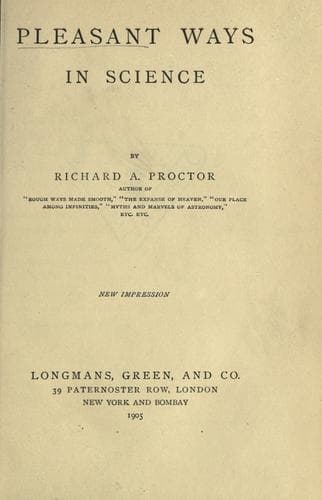
Pleasant Ways in ScienceProctor, Richard A. (Richard Anthony)
Science
Pleasant Ways in Science
Proctor, Richard A. (Richard Anthony)
Science
It is important to inquire whether the southerly drift which stopped
Parry was due to northerly winds or to a southerly current; and if
to the latter cause, whether this current probably affects the whole
extent of the sea in which Parry’s ice-field was drifting. We know
that his party were exposed, during the greater part of their advance
from Spitzbergen, to northerly winds. Now the real velocity of these
winds must have been greater than their apparent velocity, because the
ice-field was moving southwards. Had this not been the case, or had the
ice-field been suddenly stopped, the wind would have seemed stronger;
precisely as it seems stronger to passengers on board a sailing vessel
when, after being before the wind for a time, she is brought across
the wind. The ice-field was clearly travelling before the wind, but
not nearly so fast as the wind; and therefore there is good reason
for believing that the motion of the ice-field was due to the wind
alone. If we suppose this to have been really the case, then, as there
is no reason for believing that northerly winds prevail uniformly in
the Arctic regions, we must regard Parry’s defeat as due to mischance.
Another explorer might have southerly instead of northerly winds, and
so might be assisted instead of impeded in his advance towards the
Pole. Had this been Parry’s fortune, or even if the winds had proved
neutral, he would have approached nearer to the Pole than Nares. For
Parry reckoned that he had lost more than a hundred miles by the
southerly drift of the ice-field, by which amount at least he would
have advanced further north. But that was not all; for there can be
little doubt that he would have continued his efforts longer but for
the Sisyphæan nature of the struggle. It is true he was nearer home
when he turned back than he would have been but for the drift, and one
of his reasons for turning back was the consideration of the distance
which his men had to travel in returning. But he was chiefly influenced
(so far as the return journey was concerned) by the danger caused by
the movable nature of the ice-field, which might at any time begin to
travel northwards, or eastwards, or westwards.
Public-domain text, read in full here on John Shaqi.
Reviews
Reviews
No reviews yet
Be the first to share your thoughts on this work.
Elsewhere in the archive
Join the Discussion
Join the discussion
Sign in to leave a comment or review.
Sign InorCreate an account