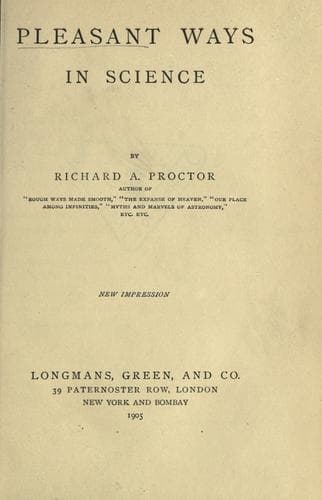
Pleasant Ways in ScienceProctor, Richard A. (Richard Anthony)
Science
Pleasant Ways in Science
Proctor, Richard A. (Richard Anthony)
Science
At Iquique, in 1868, the great wave was estimated at fifty feet in
height. We are told that it was black with the mud and slime of the sea
bottom. “Those who witnessed its progress from the upper balconies of
their houses, and presently saw its black mass rushing close beneath
their feet, looked on their safety as a miracle. Many buildings were,
indeed, washed away, and in the low-lying parts of the town there was a
terrible loss of life.” In May, 1876, the greatest mischief at Iquique
would seem to have been caused by the earthquake, not by the sea-wave,
though this also was destructive in its own way. “Iquique,” we are
told, “is in ruins. The movement was experienced there at the same time
and with the same force [as at Arica]. Its duration was exactly four
minutes and a third. It proceeded from the south-east, exactly from the
direction of Ilaga.” The houses built of wood and cane tumbled down at
the first attacks, lamps were broken, and the burning oil spread over
and set fire to the ruins. Three companies of firemen, German, Italian,
and Peruvian, were instantly at their posts, although it was difficult
to maintain an upright position, shock following shock with dreadful
rapidity. Nearly 400,000 quintals of nitrate in the stores at Iquique
and the adjacent ports of Molle and Pisagua were destroyed. The British
barque _Caprera_ and a German barque sank, and all the coasting craft
and small boats in the harbour were broken to pieces and drifted about
in every direction.
At Chanavaya, a small town at the guano-loading dépôt known as Pabellon
de Pica, only two houses were left standing out of four hundred. Here
the earthquake shock was specially severe. In some places the earth
opened in crevices seventeen yards deep and the whole surface of the
ground was changed.
At Punta de Eobos two vessels were lost, and fourteen ships more
or less damaged, by the wave. Antofagasta, Mexillones, Tocopilla,
and Cobigo, on the Bolivian coast, suffered simultaneously from the
earthquake and the sea-wave. The sea completely swept the business
portion of Antofagasta during four hours. Here a singular phenomenon
was noticed. For some time the atmosphere was illuminated with a ruddy
glow. It was supposed that this light came from the volcano of San
Pedro de Atacama, a few leagues inland from Antofagasta. A somewhat
similar phenomenon was noticed at Tacna during the earthquake of
August, 1868. About three hours after the earthquake an intensely
brilliant light made its appearance above the neighbouring mountains.
It lasted fully half an hour, and was ascribed to the eruption of some
as yet unknown volcano.
Public-domain text, read in full here on John Shaqi.
Reviews
Reviews
No reviews yet
Be the first to share your thoughts on this work.
Elsewhere in the archive
Join the Discussion
Join the discussion
Sign in to leave a comment or review.
Sign InorCreate an account