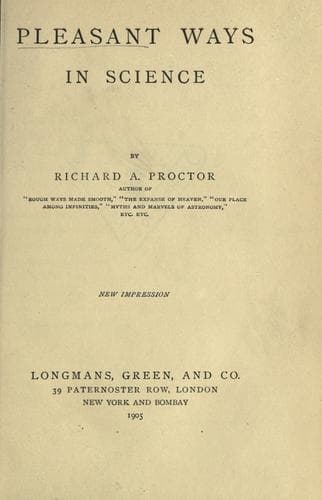
Pleasant Ways in ScienceProctor, Richard A. (Richard Anthony)
Science
Pleasant Ways in Science
Proctor, Richard A. (Richard Anthony)
Science
It is clear that the wave which traversed the Pacific in May, 1876,
was somewhat inferior in size to that of August, 1868, which therefore
still deserves to be called (as I then called it) the greatest sea-wave
ever known. The earthquake, indeed, which preceded the oceanic
disturbance of 1868 was far more destructive than that of May, 1876,
and the waves which came in upon the Peruvian and Bolivian shores were
larger. Nevertheless, the wave of May, 1876, was not so far inferior to
that of August, 1868, but that its course could be traced athwart the
entire extent of the Pacific Ocean.
When we consider the characteristic features of the Peruvian and
Chilian earthquakes, and especially when we note how wide is the extent
of the region over which their action is felt in one way or another,
it can scarcely be doubted that the earth’s Vulcanian energies are at
present more actively at work throughout that region than in any other.
There is nothing so remarkable, one may even say so stupendous, in
the history of subterranean disturbance as the alternation of mighty
earth-throes by which, at one time, the whole of the Chilian Andes seem
disturbed and anon the whole of the Peruvian Andes. In Chili scarcely
a year ever passes without earthquakes, and the same may be said of
Peru; but so far as great earthquakes are concerned the activity of the
Peruvian region seems to synchronize with the comparative quiescence
of the Chilian region, and _vice versâ_. Thus, in 1797, the terrible
earthquake occurred which is known as the earthquake of Riobamba, which
affected the entire Peruvian earthquake region. Thirty years later
a series of tremendous throes shook the whole of Chili, permanently
elevating its long line of coast to the height of several feet. During
the last twelve years the Peruvian region has in turn been disturbed by
great earthquakes. It should be added that between Chili and Peru there
is a region about five hundred miles in length in which scarcely any
volcanic action has been observed. And singularly enough, “this very
portion of the Andes, to which one would imagine that the Peruvians and
Chilians would fly as to a region of safety, is the part most thinly
inhabited; insomuch that, as Von Buch observes, it is in some places
entirely deserted.”
Public-domain text, read in full here on John Shaqi.
Reviews
Reviews
No reviews yet
Be the first to share your thoughts on this work.
Elsewhere in the archive
Join the Discussion
Join the discussion
Sign in to leave a comment or review.
Sign InorCreate an account