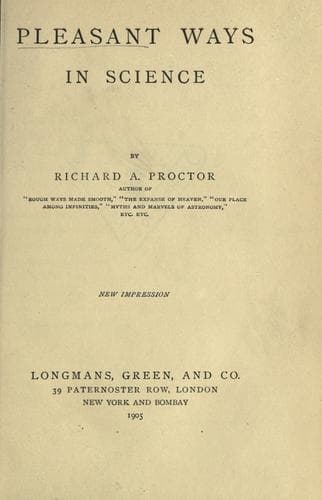
Pleasant Ways in ScienceProctor, Richard A. (Richard Anthony)
Science
Pleasant Ways in Science
Proctor, Richard A. (Richard Anthony)
Science
The oceans and continents of our earth must be clearly discernible from
her nearer neighbours among the planets—from Venus and Mercury on the
inner side of her path around the sun, and from Mars (though under
less favourable conditions) from the outer side. When we consider,
indeed, that the lands and seas of Mars can be clearly discerned with
telescopic aid from our earth at a distance of forty millions of miles,
we perceive that our earth, seen from Venus at little more than half
this distance, must present a very interesting appearance. Enlarged,
owing to greater proximity, nearly fourfold, having a diameter nearly
twice as great as that of Mars, so that at the same distance her disc
would seem more than three times as large, more brightly illuminated
by the sun in the proportion of about five to two, she would shine
with a lustre exceeding that of Mars, when in full brightness in the
midnight sky, about thirty times; and all her features would of course
be seen with correspondingly increased distinctness. Moreover, the
oceans of our earth are so much larger in relative extent than those
of Mars, covering nearly three-fourths instead of barely one-half of
the surface of the world they belong to, that they would appeal as far
more marked and characteristic features than the seas and lakes of
Mars. When the Pacific Ocean, indeed, occupies centrally the disc of
the earth which at the moment is turned towards any planet, nearly the
whole of that disc must appear to be covered by the ocean. Under such
circumstances the passage of a wide-spreading series of waves over the
Pacific, at the rate of about 500 miles an hour, is a phenomenon which
could scarcely fail to be discernible from Venus or Mercury, if either
planet chanced to be favourably placed for the observation of the
earth—always supposing there were observers in Mercury or Venus, and
that these observers were provided with powerful telescopes.
Public-domain text, read in full here on John Shaqi.
Reviews
Reviews
No reviews yet
Be the first to share your thoughts on this work.
Elsewhere in the archive
Join the Discussion
Join the discussion
Sign in to leave a comment or review.
Sign InorCreate an account