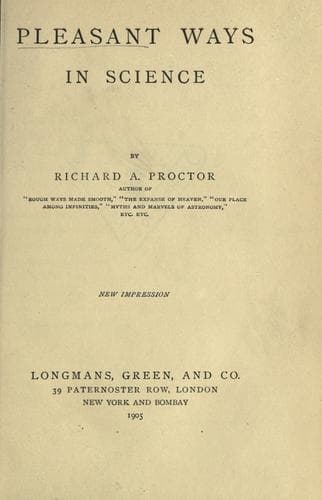
Pleasant Ways in ScienceProctor, Richard A. (Richard Anthony)
Science
Pleasant Ways in Science
Proctor, Richard A. (Richard Anthony)
Science
Where the interval between the passage of successive wave-crests was
noted, we can tell the actual breadth of the wave. Thus, at the Samoan
Isles, in 1868, the crests succeeded each other at intervals of sixteen
minutes, corresponding to eight minutes between crest and trough.
But we have seen, that if the waves were one mile in breadth, the
corresponding interval would be only four seconds, or only one 120th
part of eight minutes: it follows, then, that the breadth of the great
wave, where it reached the Samoan Isles in 1868, was about 120 miles.
Now a wave extending right athwart the Pacific Ocean, and having a
cross breadth of more than 120 miles, would be discernible as a marked
feature of the disc of our earth, seen under the conditions described
above, either from Mercury or Venus. It is true that the slope of
the wave’s advancing and following surfaces would be but slight, yet
the difference of the illumination under the sun’s rays would be
recognizable. Then, also, it is to be remembered that there was not
merely a single wave, but a succession of many waves. These travelled
also with enormous velocity; and though at the distance of even the
nearest planet, the apparent motion of the great wave, swift though
it was in reality, would be so far reduced that it would have to be
estimated rather than actually seen, yet there would be no difficulty
in thus perceiving it with the mind’s eye. The rate of motion indeed
would almost be exactly the same as that of the equatorial part of the
surface of Mars, in consequence of the planet’s rotation; and this
(as is well known to telescopists), though not discernible directly,
produces, even in a few minutes, changes which a good eye can clearly
recognize. We can scarcely doubt then that if our earth were so
situated at any time when one of the great waves generated by Peruvian
earthquakes in traversing the Pacific, that the hemisphere containing
this ocean were turned fully illuminated towards Venus (favourably
placed for observing her), the disturbance of the Pacific could be
observed and measured by telescopists on that planet.
Unfortunately there is little chance that terrestrial observers will
ever be able to watch the progress of great waves athwart the oceans of
Mars, and still less that any disturbance of the frame of Venus should
become discernible to us by its effects. We can scarce even be assured
that there are lands and seas on Venus, so far as direct observation is
concerned, so unfavourably is she always placed for observation; and
though we see Mars under much more favourable conditions, his seas are
too small and would seem to be too shallow (compared with our own) for
great waves to traverse them such as could be discerned from the earth.
Public-domain text, read in full here on John Shaqi.
Reviews
Reviews
No reviews yet
Be the first to share your thoughts on this work.
Elsewhere in the archive
Join the Discussion
Join the discussion
Sign in to leave a comment or review.
Sign InorCreate an account