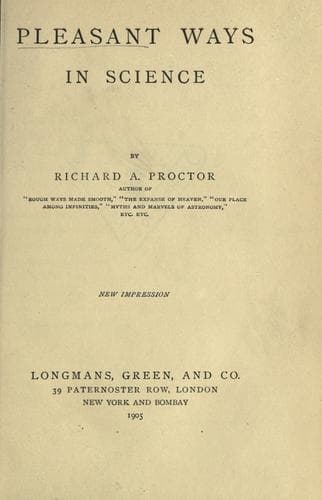
Pleasant Ways in ScienceProctor, Richard A. (Richard Anthony)
Science
Pleasant Ways in Science
Proctor, Richard A. (Richard Anthony)
Science
This view of the so-called fabulous animals of antiquity has been
confirmed by the results of modern zoological research. The merman,
zoologically possible (not in all details, of course, but generally),
has found its antitype in the dugong and the manatee; the roc in the
condor, or perhaps in those extinct species whose bones attest their
monstrous proportions; the unicorn in the rhinoceros; even the dragon
in the pterodactyl of the green-sand; while the centaur, the minotaur,
the winged horse, and so forth, have become recognized as purely
imaginary creatures, which had their origin simply in the fanciful
combination of known forms, no existent creatures having even suggested
these monstrosities.
It is not to be wondered at that the sea should have been more prolific
in monstrosities and in forms whose real nature has been misunderstood.
Land animals cannot long escape close observation. Even the most
powerful and ferocious beasts must succumb in the long run to man, and
in former ages, when the struggle was still undecided between some race
of animals and savage man, individual specimens of the race must often
have been killed, and the true appearance of the animal determined.
Powerful winged animals might for a longer time remain comparatively
mysterious creatures even to those whom they attacked, or whose flocks
they ravaged. A mighty bird, or a pterodactylian creature (a late
survivor of a race then fast dying out), might swoop down on his prey
and disappear with it too swiftly to be made the subject of close
scrutiny, still less of exact scientific observation. Yet the general
characteristics even of such creatures would before long be known.
From time to time the strange winged monster would be seen hovering
over the places where his prey was to be found. Occasionally it would
be possible to pierce one of the race with an arrow or a javelin; and
thus, even in those remote periods when the savage progenitors of the
present races of man had to carry on a difficult contest with animals
now extinct or greatly reduced in power, it would become possible to
determine accurately the nature of the winged enemy. But with sea
creatures, monstrous, or otherwise, the case would be very different.
To this day we remain ignorant of much that is hidden beneath the
waves of the “hollow-sounding and mysterious main.” Of far the greater
number of sea creatures, it may truly be said that we never see any
specimens except by accident, and never obtain the body of any except
by very rare accident. Those creatures of the deep sea which we are
best acquainted with, are either those which are at once very numerous
and very useful as food or in some other way, or else those which are
very rapacious and thus expose themselves, by their attacks on men,
to counter-attack and capture or destruction. In remote times, when
men were less able to traverse the wide seas, when, on the one hand,
attacks from great sea creatures were more apt to be successful,
Public-domain text, read in full here on John Shaqi.
Reviews
Reviews
No reviews yet
Be the first to share your thoughts on this work.
Elsewhere in the archive
Join the Discussion
Join the discussion
Sign in to leave a comment or review.
Sign InorCreate an account