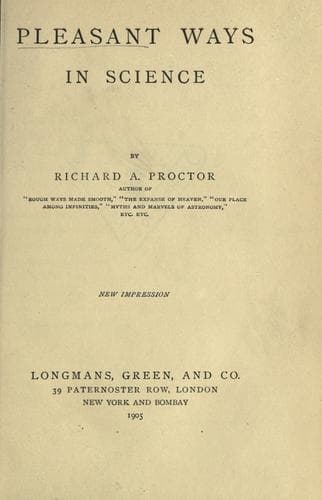
Pleasant Ways in ScienceProctor, Richard A. (Richard Anthony)
Science
Pleasant Ways in Science
Proctor, Richard A. (Richard Anthony)
Science
It would not be saying too much to assert that if the so-called
sea-serpent were really a serpent, its entire length must be nearer
1000 than 100 feet. This, of course, is utterly incredible. We are,
therefore, forced to the belief that the creature is not a serpent.
If it were a long-necked reptile, with a concealed body much bulkier
than the neck, the requirements of floatation would be satisfied; if
to that body there were attached powerful paddles, the requirements
of propulsion would be satisfied. The theory, then, suggested, first
by Mr. Newman, later but independently by Mr. Stirling, and advocated
since by several naturalists of repute, is simply that the so-called
sea-serpent is a modern representative of the long-necked plesiosaurian
reptile to which has been given the name of the _enaliosaurus_.
Creatures of this kind prevailed in that era when what is called the
lias was formed, a fossiliferous stratum belonging to the secondary or
mesozoic rocks. They are not found in the later or tertiary rocks, and
thereon an argument might be deduced against their possible existence
in the present, or post-tertiary, period; but, as will presently be
shown, this argument is far from being conclusive. The enaliosaurian
reptiles were “extraordinary,” says Lyell, “for their number, size, and
structure.” Like the ichthyosauri, or fish-lizards, the enaliosauri
(or serpent-turtles, as they might almost be called) were carnivorous,
their skeletons often enclosing the fossilized remains of half-digested
fishes. They had extremely long necks, with heads very small compared
with the body. They are supposed to have lived chiefly in narrow seas
and estuaries, and to have breathed air like the modern whales and
other aquatic mammals. Some of them were of formidable dimensions,
though none of the skeletons yet discovered indicate a length of more
than 35 feet. It is not, however, at all likely that the few skeletons
known indicate the full size attained by these creatures. Probably,
indeed, we have the remains of only a few out of many species, and
some species existing in the mesozoic period may have as largely
exceeded those whose skeletons have been found, as the boa-constrictor
exceeds the common ringed snake. It is also altogether probable that
in the struggle for existence during which the enaliosaurian reptiles
have become _almost_ extinct (according to the hypothesis we are
considering), none but the largest and strongest had any chance, in
which case the present representatives of the family would largely
exceed in bulk their progenitors of the mesozoic period.
Public-domain text, read in full here on John Shaqi.
Reviews
Reviews
No reviews yet
Be the first to share your thoughts on this work.
Elsewhere in the archive
Join the Discussion
Join the discussion
Sign in to leave a comment or review.
Sign InorCreate an account