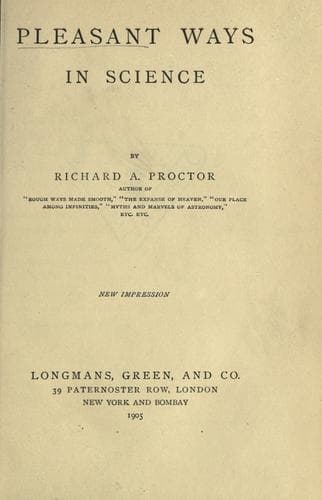
Pleasant Ways in ScienceProctor, Richard A. (Richard Anthony)
Science
Pleasant Ways in Science
Proctor, Richard A. (Richard Anthony)
Science
As for the absence of remains, Mr. Darwin has pointed out that
the fossils we possess are but fragments accidentally preserved
by favouring circumstances in an almost total wreck. We have many
instances of existent creatures, even such as would have a far better
chance of floating after death, and so getting stranded where their
bones might be found, which have left no trace of their existence. A
whale possessing two dorsal fins was said to have been seen by Smaltz,
a Sicilian naturalist; but the statement was rejected, until a shoal
of these whales were seen by two eminent French zoologists, MM. Quoy
and Gaimard. No carcase, skeleton, or bone of this whale has ever
been discovered. For seventeen hours a ship, in which Mr. Gosse was
travelling to Jamaica, was surrounded by a species of whale never
before noticed—30 feet long, black above and white beneath, with
swimming paws white on the upper surface. Here, he says, was “a whale
of large size, occurring in great numbers in the North Atlantic, which
on no other occasion has fallen under scientific observation. The
toothless whale of Havre, a species actually inhabiting the British
Channel, is only known from a single specimen accidentally stranded on
the French coast; and another whale, also British, is known only from
a single specimen cast ashore on the Elgin roast, and there seen and
described by the naturalist Sowerby.
Dr. Andrew Wilson, in an interesting paper, in which he maintains that
sea-serpent tales are not to be treated with derision, but are worthy
of serious consideration, “supported as they are by zoological science,
and in the actual details of the case by evidence as trustworthy in
many cases as that received in our courts of law,” expresses the
opinion that plesiosauri and ichthyosauri have been unnecessarily
disinterred to do duty for the sea-serpents. But he offers as an
alternative only the ribbon-fish; and though some of these may attain
enormous dimensions, yet we have seen that some of the accounts of
the supposed sea-serpent, and especially the latest narrative by the
captain and crew of the _Pauline_, cannot possibly be explained by any
creature so flat and relatively so feeble as the ribbon-fish.
On the whole, it appears to me that a very strong case has been made
out for the enaliosaurian, or serpent-turtle, theory of the so-called
sea-serpent.
Public-domain text, read in full here on John Shaqi.
Reviews
Reviews
No reviews yet
Be the first to share your thoughts on this work.
Elsewhere in the archive
Join the Discussion
Join the discussion
Sign in to leave a comment or review.
Sign InorCreate an account