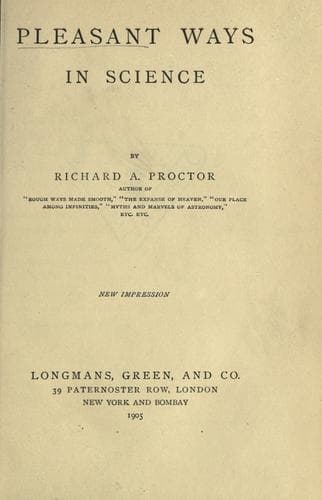
Pleasant Ways in ScienceProctor, Richard A. (Richard Anthony)
Science
Pleasant Ways in Science
Proctor, Richard A. (Richard Anthony)
Science
Now, in duplex telegraphy the artificial current must be equal to the
chief current in intensity all the time; so that, since in submarine
telegraphy the current rises gradually to its full strength and as
gradually subsides, the artificial current must do the same. Reverting
to the illustration derived from the flow of water, if we had a small
pipe the rapid flow through which was to carry as much water one way as
the slow flow through a large pipe was to carry water the other way,
then if the large pipe had a widening along one part of its long course
the short pipe would require to have a similar widening along the
corresponding part of its short course. And to make the illustration
perfect, the widenings along the large pipe should be unequal in
different parts of the pipe’s length; for the capacity of a submarine
cable, regarded as a condenser, is different along different parts of
its length. What is wanted, then, for a satisfactory system of duplex
telegraphy in the case of submarine cables, is an artificial circuit
which shall not only correspond as a whole to the long circuit, but
shall reproduce at the corresponding parts of its own length all the
varieties of capacity existing along various parts of the length of the
submarine cable.
Several attempts have been made by electricians to accomplish this
result. Let it be noticed that two points have to be considered: the
intensity of the current’s action, which depends on the resistance
it has to overcome in traversing the circuit; and the velocity of
transmission, depending on the capacity of various parts of the circuit
to condense or collect electricity. Varley, Stearn, and others have
endeavoured by various combinations of condensers with resistance coils
to meet these two requisites. But the action of artificial circuits
thus arranged was not sufficiently uniform. Recently Mr. J. Muirhead,
jun., has met the difficulty in the following way (I follow partially
the account given in the _Times_ of February 3, 1877, which the reader
will now have no difficulty in understanding):—He has formed his
second circuit by sheets of paper prepared with paraffin, and having
upon one side a strip of tinfoil, wound to and fro to represent
resistance. Through this the artificial current is conducted. On the
other side is a sheet of tinfoil to represent the sheathing,[29] and
to correspond to the capacity of the wire. Each sheet of paper thus
prepared may be made to represent precisely a given length of cable,
having enough tinfoil on one side to furnish the resistance, and on the
other to furnish the capacity. A sufficient number of such sheets would
exactly represent the cable, and thus the artificial or non-signalling
part of the current would be precisely equivalent to the signalling
part, so far as its action on the needle at the transmitting station
was concerned. “The new plan was first tried on a working scale,” says
the _Times_, “on the line between Marseilles and Bona; but it has
Public-domain text, read in full here on John Shaqi.
Reviews
Reviews
No reviews yet
Be the first to share your thoughts on this work.
Elsewhere in the archive
Join the Discussion
Join the discussion
Sign in to leave a comment or review.
Sign InorCreate an account