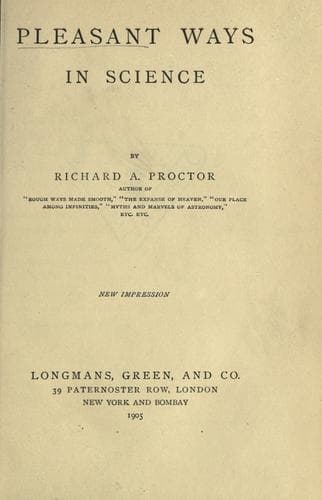
Pleasant Ways in ScienceProctor, Richard A. (Richard Anthony)
Science
Pleasant Ways in Science
Proctor, Richard A. (Richard Anthony)
Science
The telephonic successes recently achieved by Mr. Gray were in
part anticipated by La Cour, of Copenhagen, whose method may be
thus described: At the transmitting station a tuning-fork is set
in vibration. At each vibration one of the prongs touches a fine
strip of metal completing a circuit. At the receiving station the
wire conveying the electric current is coiled round the prongs of
another tuning-fork of the same tone, but without touching them.
The intermittent current, corresponding as it does with the rate of
vibration proper to the receiving fork, sets this fork in vibration;
and in La Cour’s instrument the vibrations of the receiving fork
were used to complete the circuit of a local battery. His object was
not so much the production of tones as the use of the vibrations
corresponding to different tones, to act on different receiving
instruments. For only a fork corresponding to the sending fork could
be set in vibration by the intermittent current resulting from the
latter’s vibrations. So that, if there were several transmitting forks,
each could send its own message at the same time, each receiving fork
responding only to the vibrations of the corresponding transmitting
fork. La Cour proposed, in fact, that his instrument should be used
in combination with other methods of telegraphic communication. Thus,
since the transmitting fork, whenever put in vibration, sets the local
battery of the receiving station at work, it can be used to work a
Morse instrument, or it could work an ordinary Wheatstone and Cook
instrument, or it could be used for a pantelegraph. The same wire, when
different forks are used, could work simultaneously several instruments
at the receiving station. One special use indicated by La Cour was the
adaptation of his system to the Caselli pantelegraph, whereby, instead
of one style, a comb of styles might be carried over the transmitting
and recording plates. It would be necessary, in all such applications
of his method (though, strangely enough, La Cour’s description makes
no mention of the point), that the vibrations of the transmitting fork
should admit of being instantly stopped or “damped.”
Public-domain text, read in full here on John Shaqi.
Reviews
Reviews
No reviews yet
Be the first to share your thoughts on this work.
Elsewhere in the archive
Join the Discussion
Join the discussion
Sign in to leave a comment or review.
Sign InorCreate an account