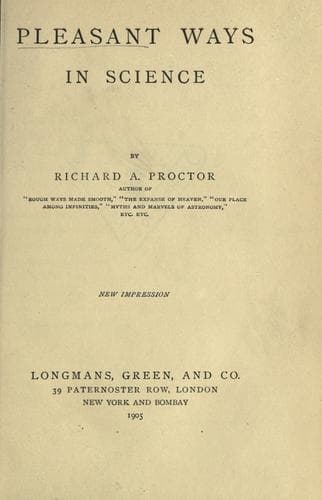
Pleasant Ways in ScienceProctor, Richard A. (Richard Anthony)
Science
Pleasant Ways in Science
Proctor, Richard A. (Richard Anthony)
Science
The last paragraph had barely been written when news arrived of another
form of telephone, surpassing Gray’s and La Cour’s in some respects as
a conveyor of musical tones, but as yet unable to speak like Bell’s. It
is the invention of Mr. Edison, an American electrician. He calls it
the motograph. He discovered about six years ago the curious property
on which the construction of the instrument depends. If a piece of
paper moistened with certain chemical solutions is laid upon a metallic
plate connected with the positive pole of a galvanic battery, and a
platinum wire connected with the negative pole is dragged over the
moistened paper, the wire slides over the paper like smooth iron over
ice—the usual friction disappearing so long as the current is passing
from the wire to the plate through the paper. At the receiving station
of Mr. Edison’s motograph there is a resonating box, from one face
of which extends a spring bearing a platinum point, which is pressed
by the spring upon a tape of chemically prepared paper. This tape is
steadily unwound, drawing by its friction the platinum point, and
with it the face of the resonator, outwards. This slight strain on
the face of the resonator continues so long as no current passes from
the platinum point to the metallic drum over which the moistened tape
is rolling. But so soon as a current passes, the friction immediately
ceases, and the face of the resonator resumes its normal position. If
then at the transmitting station there is a membrane or a very fine
diaphragm (as in Reuss’s or Bell’s arrangement) which is set vibrating
by a note of any given tone, the current, as in those arrangements, is
transmitted and stopped at intervals corresponding to the tone, and the
face of the resonating box is freed and pulled at the same intervals.
Hence, it speaks the corresponding tone. The instrument appears to have
the advantage over Gray’s in range. In telegraphic communication Gray’s
telephone is limited to about one octave. Edison’s extends from the
deepest bass notes to the highest notes of the human voice, which, when
magnets are employed, are almost inaudible. But Edison’s motograph has
yet to learn to speak.
Public-domain text, read in full here on John Shaqi.
Reviews
Reviews
No reviews yet
Be the first to share your thoughts on this work.
Elsewhere in the archive
Join the Discussion
Join the discussion
Sign in to leave a comment or review.
Sign InorCreate an account