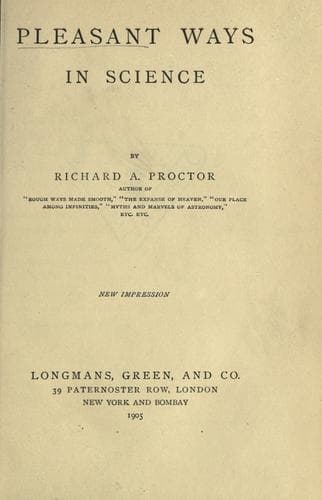
Pleasant Ways in ScienceProctor, Richard A. (Richard Anthony)
Science
Pleasant Ways in Science
Proctor, Richard A. (Richard Anthony)
Science
Now if we consider the meaning of such results as these, we shall begin
to recognize the perplexing but also instructive character of the
evidence derived from the telephone, and applied to the construction
of the phonograph. It appears that when a disc is vibrating under such
special conditions as to give forth a particular series of tones (the
so-called fundamental tone of the disc and other tones combined with it
which belong to its series of overtones), the various parts of the disc
are vibrating to and fro in a direction square to the face of the disc,
except certain points at which there is no vibration, these points
together forming curves of special forms along the substance of the
disc.
When, on the other hand, tones of various kinds are sounded in the
neighbourhood of a disc or of a stretched circular membrane, we may
assume that the different parts of the disc are set in vibration after
a manner at least equally complicated. If the tones belong to the
series which could be emitted by the diaphragm when struck, we can
understand that the vibrations of the diaphragm would resemble those
which would result from a blow struck under special conditions. When
other tones are sounded, it may be assumed that the sound-waves which
reach the diaphragm cause it to vibrate as though not the circumference
(only) but a circle in the substance of the diaphragm—concentric,
of course, with the circumference, and corresponding in dimensions
with the tone of the sounds—were fixed. If a drum of given size is
struck, we hear a note of particular tone. If we heard, as the result
of a blow on the same drum, a much higher tone, we should know that
in some way or other the effective dimensions of the drum-skin had
been reduced—as for instance, by a ring firmly pressed against the
inside of the skin. So when a diaphragm is responding to tones other
than those corresponding to its size, tension, etc., we infer that the
sound-waves reaching it cause it to behave, so far as its effective
vibrating portion is concerned, as though its conformation had altered.
When several tones are responded to by such a diaphragm, we may infer
that the vibrations of the diaphragm are remarkably complicated.
Now the varieties of vibratory motion to which the diaphragm of the
telephone has been made to respond have been multitudinous. Not only
have all orders of sound singly and together been responded to, but
vocal sounds which in many respects differ widely from ordinary tones
are repeated, and the peculiarities of intonation which distinguish one
voice from another have been faithfully reproduced.
Let us consider in what respects vocal sounds, and especially the
sounds employed in speech, differ from mere combinations of ordinary
tones.
Public-domain text, read in full here on John Shaqi.
Reviews
Reviews
No reviews yet
Be the first to share your thoughts on this work.
Elsewhere in the archive
Join the Discussion
Join the discussion
Sign in to leave a comment or review.
Sign InorCreate an account