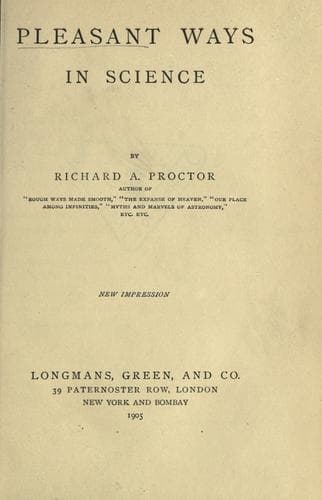
Pleasant Ways in ScienceProctor, Richard A. (Richard Anthony)
Science
Pleasant Ways in Science
Proctor, Richard A. (Richard Anthony)
Science
But this is not all, even as regards the vowel sounds, the most
readily reproducible peculiarities of ordinary speech. Spoken sounds
differ from musical sounds properly so called, in varying in pitch
throughout their continuance. So far as tone is concerned, apart from
vowel quality, the speech note may be imitated by sliding a finger up
the finger-board of a violin while the bow is being drawn. A familiar
illustration of the varying pitch of a speech note is found in the
utterance of Hamlet’s question, “Pale, or red?” with intense anxiety of
inquiry, if one may so speak. “The speech note on the word ‘pale’ will
consist of an upward movement of the voice, while that on ‘red’ will
be a downward movement, and in both words the voice will traverse an
interval of pitch so wide as to be conspicuous to ordinary ears; while
the cultivated perception of the musician will detect the voice moving
through a less interval of pitch while he is uttering the word ‘or’
of the same sentence. And he who can record in musical notation the
sounds which he hears, will perceive the musical interval traversed in
these vocal movements, and the place also of these speech notes on the
musical staff.” Variations of this kind, only not so great in amount,
occur in ordinary speech; and no telephonic or phonographic instrument
could be regarded as perfect, or even satisfactory, which did not
reproduce them.
But the vowel sounds are, after all, combinations and modifications
of musical tones. It is otherwise with consonantal sounds, which, in
reality, result from various ways in which vowel sounds are commenced,
interrupted (wholly or partially), and resumed. In one respect this
statement requires, perhaps, some modification—a point which has not
been much noticed by writers on vocal sounds. In the case of liquids,
vowel sounds are not partially interrupted only, as is commonly stated.
They cease entirely as vowel sounds, though the utterance of a vocal
sound is continued when a liquid consonant is uttered. Let the reader
utter any word in which a liquid occurs, and he will find that while
the liquid itself is sounded the vowel sounds preceding or following
the liquid cease entirely. Repeating slowly, for example, the word
“remain,” dwelling on all the liquids, we find that while the “r” is
being sounded the “ē” sound cannot be given, and this sound ceases so
soon as the “m” is sounded; similarly the long “a” sound can only be
uttered when the “m” sound ceases, and cannot be carried on into the
sound of the final liquid “n.” The liquids are, in fact, improperly
called semi-vowels, since no vowel sound can accompany their utterance.
The tone, however, with which they are sounded can be modified during
their utterance. In sounding labials the emission of air is not stopped
completely at any moment. The same is true of the sibilants s, z, sh,
zh, and of the consonants g, j, f, v, th (hard and soft). These are
called, on this account, _continuous_ consonants.
Public-domain text, read in full here on John Shaqi.
Reviews
Reviews
No reviews yet
Be the first to share your thoughts on this work.
Elsewhere in the archive
Join the Discussion
Join the discussion
Sign in to leave a comment or review.
Sign InorCreate an account