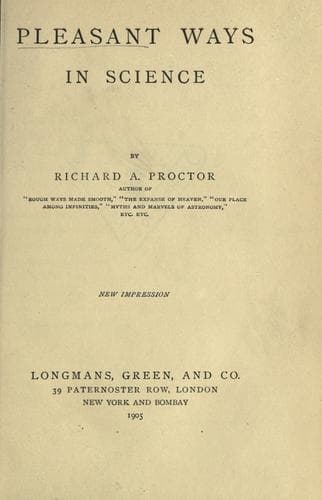
Pleasant Ways in ScienceProctor, Richard A. (Richard Anthony)
Science
Pleasant Ways in Science
Proctor, Richard A. (Richard Anthony)
Science
of the diaphragm, but also over a range all round its mean position,
corresponding to the play of the end of the pointer around _its_ mean
position. The groove allows the pressure of the pointer against the
tinfoil free action. If the cylinder had no groove the dead resistance
of the tinfoil, thus backed up by an unyielding surface, would stop
the play of the pointer. Under the actual conditions, the tinfoil
is only kept taut enough to receive the impressions, while yielding
sufficiently to let the play of the pointer continue unrestrained.
If now a person speaks into the receiving tube, and the handle of
the cylinder be turned, the vibrations of the pointer are impressed
upon the portion of the tinfoil lying over the hollow groove, and are
retained by it. They will be more or less deeply marked according to
the quality of the sounds emitted, and according also, of course, to
the strength with which the speaker utters the sounds, and to the
nature of the modulations and inflexions of his voice. The result is
a message verbally imprinted upon a strip of metal. It differs from
the result in the case of Barlow’s logograph, in being virtually a
record in three dimensions instead of one only. The varying depth of
the impressions corresponds to the varying height of the curve in
Barlow’s diagrams; but there the resemblance ceases; for that was
the single feature which Barlow’s logographs could present. Edison’s
imprinted words show, besides varying depth of impression, a varying
range on either side of the mean track of the pointer, and also—though
the eye is not able to detect this effect—there is a varying rate of
progression according as the end of the pointer has been swayed towards
or from the direction in which, owing to the motion of the cylinder,
the pointer is virtually travelling.
We may say of the record thus obtained that it is sound presented
in a visible form. A journalist who has written on the phonograph
has spoken of this record as corresponding to the crystallization of
sound. And another who, like the former, has been (erroneously, but
that is a detail) identified with myself, has said, in like fanciful
vein, that the story of Baron Münchausen hearing words which had been
frozen during severe cold melting into speech again, so that all the
babble of a past day came floating about his ears, has been realized
by Edison’s invention. Although such expressions may not be, and in
point of fact are not, strictly scientific, I am not disposed, for my
own part, to cavil with them. If they could by any possibility be taken
_au pied de la lettre_ (and, by the way, we find quite a new meaning
for this expression in the light of what is now known about vowels
and consonants), there would be valid objection to their use. But, as
no one supposes that Edison’s phonograph really crystallizes words or
freezes sounds, it seems hypercritical to denounce such expressions as
the critic of the _Telegraphic Journal_ has denounced them.
Public-domain text, read in full here on John Shaqi.
Reviews
Reviews
No reviews yet
Be the first to share your thoughts on this work.
Elsewhere in the archive
Join the Discussion
Join the discussion
Sign in to leave a comment or review.
Sign InorCreate an account