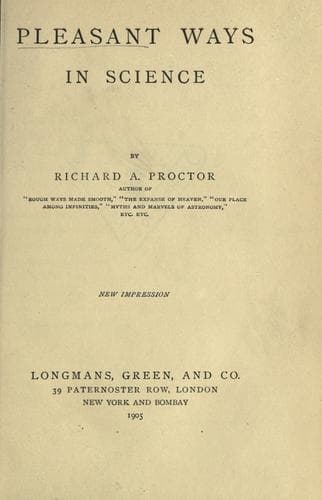
Pleasant Ways in ScienceProctor, Richard A. (Richard Anthony)
Science
Pleasant Ways in Science
Proctor, Richard A. (Richard Anthony)
Science
I forbear from dwelling further on the interest and value of this
noble invention, or of considering some of the developments which it
will probably receive before long, for already I have occupied more
space than I had intended. I have no doubt that in these days it will
bring its inventor less credit, and far less material gain, than would
be acquired from the invention of some ingenious contrivance for
destroying many lives at a blow, bursting a hole as large as a church
door in the bottom of an ironclad, or in some other way helping men to
carry out those destructive instincts which they inherit from savage
and brutal ancestors. But hereafter, when the representatives of the
brutality and savagery of our nature are held in proper disesteem, and
those who have added new enjoyments to life are justly valued, a high
place in the esteem of men will be accorded to him who has answered
one-half of the poet’s aspiration,
“Oh for the touch of a vanished hand,
And the sound of a voice that is still!”
* * * * *
NOTE.—Since the present paper was written, M. Aurel de Ratti has
made some experiments which he regards as tending to show that there
is no mechanical vibration. Thus, “when the cavities above and below
the iron disc of an ordinary telephone are filled with wadding, the
instrument will transmit and speak with undiminished clearness. On
placing a finger on the iron disc opposite the magnet, the instrument
will transmit and speak distinctly, only ceasing to act when sufficient
pressure is applied to bring plate and magnet into contact. Connecting
the centre of the disc by means of a short thread with an extremely
sensitive membrane, no sound is given out by the latter when a message
is transmitted. Bringing the iron cores of the double telephone in
contact with the disc, and pressing with the fingers against the
plate on the other side, a weak current from a Daniell cell produced
a distinct click in the plate, and on drawing a wire from the cell
over a file which formed part of the circuit, a rattling noise was
produced in the instrument.” If these experiments had been made
before the phonograph was invented, they would have suggested the
impracticability of constructing any instrument which would do what the
phonograph actually does, viz., cause sounds to be repeated by exciting
a merely mechanical vibration of the central part of a thin metallic
disc. But as the phonograph proves that this can actually be done,
we must conclude that M. Aurel de Ratti’s experiments will not bear
the interpretation he places upon them. They show, nevertheless, that
exceedingly minute vibrations of probably a very small portion of the
telephonic disc suffice for the distinct transmission of vocal sounds.
This might indeed be inferred from the experiments of M. Demozet, of
Nantes, who finds that the vibrations of the transmitting telephone
are in amplitude little more than 1-2000th those of the receiving
telephone.
Public-domain text, read in full here on John Shaqi.
Reviews
Reviews
No reviews yet
Be the first to share your thoughts on this work.
Elsewhere in the archive
Join the Discussion
Join the discussion
Sign in to leave a comment or review.
Sign InorCreate an account