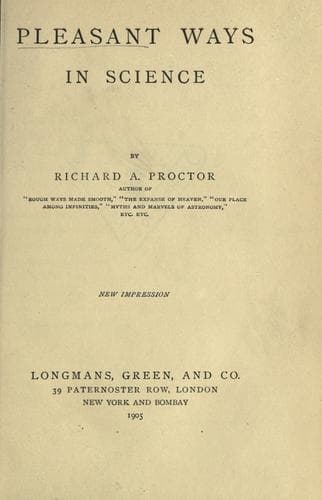
Pleasant Ways in ScienceProctor, Richard A. (Richard Anthony)
Science
Pleasant Ways in Science
Proctor, Richard A. (Richard Anthony)
Science
Still it seems tolerably clear that the choice as to the race of apes
which must be regarded as first in intelligence, and therefore as on
the whole the most manlike, rests between the orang-outang and the
chimpanzee. “In the world of science, as in that of politics,” said
Professor Rolleston in 1862, “France and England have occasionally
differed as to their choice between rival candidates for royalty. If
either hereditary claims or personal merits affect at all the right
of succession, beyond a question the gorilla is but a pretender, and
one or other of the two (other) candidates the true prince. There is
a graceful as well as an ungraceful way of withdrawing from a false
position, and the British public will adopt the graceful course
by accepting forthwith and henceforth the French candidate”—the
orang-outang. If this were intended as prophecy, it has not been
fulfilled by the event, for the gorilla is still regarded by most
British naturalists as the ape which comes on the whole nearest to man;
but probably, in saying “the British public will adopt the graceful
course” in accepting the orang-outang as “the king of the Simiadæ,”
Professor Rolleston meant only that that course would be graceful if
adopted.
Before the discovery of the gorilla, the chimpanzee was usually
regarded as next to man in the scale of the animal creation. It was
Cuvier who first maintained the claim of the orang-outang to this
position. Cuvier’s opinion was based on the greater development
of the orang-outang’s brain, and the height of its forehead. But
these marks of superiority belong to the orang only when young. The
adult orang seems to be inferior, or at least not superior, to the
chimpanzee as respects cerebral formation, and in other respects seems
less to resemble man. The proportions of his body, his long arms,
high shoulders, deformed neck, and imperfect ears are opposed to its
claims to be regarded as manlike. In all these respects, save one, the
chimpanzee seems to be greatly its superior. (The ear of the chimpanzee
is large, and not placed as with us: that of the gorilla is much more
like man’s.)
Public-domain text, read in full here on John Shaqi.
Reviews
Reviews
No reviews yet
Be the first to share your thoughts on this work.
Elsewhere in the archive
Join the Discussion
Join the discussion
Sign in to leave a comment or review.
Sign InorCreate an account