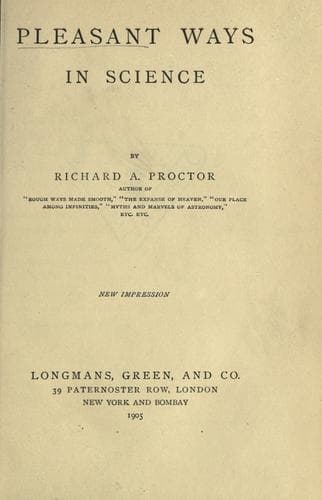
Pleasant Ways in ScienceProctor, Richard A. (Richard Anthony)
Science
Pleasant Ways in Science
Proctor, Richard A. (Richard Anthony)
Science
The siamang inhabits Sumatra. It presents several points of resemblance
to the orang-outang, but is also in several respects strongly
distinguished from that animal. The arms are longer even than the
orang’s, and the peculiar use which the orang makes of his long arms
is more strikingly shown in the progression of the long-armed siamang,
for the body inclining slightly forward, when the animal is on level
ground the long arms are used somewhat like crutches, and they advance
by jerks resembling the hobbling of a lame man whom fear compels
to make an extraordinary effort. The skull is small, and much more
depressed than that of the orang or chimpanzee. The face is naked and
black, straggling red hairs marking the eyebrows. The eyes are deeply
sunk, a peculiarity which, by the way, seems characteristic of arboreal
creatures generally;[37] the nose broad and flat, with wide-open
nostrils; the cheeks sunk under high cheekbones; the chin almost
rudimentary. “The hair over the whole body is thick, long, and of a
glossy black colour, much closer on the shoulders, back, and limbs than
on the belly, which, particularly in the females, is nearly naked. The
ears are entirely concealed by the hair of the head; they are naked,
and, like all the other naked parts, of a deep black colour. Beneath
the chin there is a large, bare sac, of a lax and oily appearance,
which is distended with air when the animal cries, and in that state
resembles an enormous goitre. It is similar to that possessed by
the orang-outang, and undoubtedly assists in swelling the volume of
the voice, and producing those astounding cries which, according to
Duvancelle’s account, may be heard at the distance of several miles.”
This, however, may be doubted, for M. Duvancelle himself remarks of the
wouwou, that, “though deprived of the guttural sac so remarkable in the
siamang, its cry is very nearly the same; so that it would appear that
this organ does not produce the effect of increasing the sound usually
attributed to it, or else that it must be replaced in the wouwou by
some analogous formation.”
The habits of the siamang are interesting, especially in their bearing
on the relationship between the various orders of anthropoid apes
and man; for, though the gibbon is unquestionably the lowest of the
four orders of the anthropoid apes in intelligence, it possesses
some characteristics which bring it nearer to man (so far as they
are concerned) than any of its congeners. The chief authorities
respecting the ways of the siamang are the French naturalists Diard and
Duvancelle, and the late Sir Stamford Raffles.
Public-domain text, read in full here on John Shaqi.
Reviews
Reviews
No reviews yet
Be the first to share your thoughts on this work.
Elsewhere in the archive
Join the Discussion
Join the discussion
Sign in to leave a comment or review.
Sign InorCreate an account