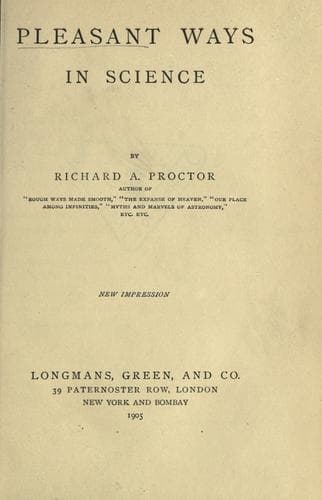
Pleasant Ways in ScienceProctor, Richard A. (Richard Anthony)
Science
Pleasant Ways in Science
Proctor, Richard A. (Richard Anthony)
Science
“However numerous the troop may be, if one is wounded it is immediately
abandoned by the rest, unless, indeed, it happen to be a young one.
Then the mother, who either carries it or follows close behind, stops,
falls with it, and, uttering the most frightful cries, precipitates
herself upon the common enemy with open mouth and arms extended. But it
is manifest that these animals are not made for combat; they neither
know how to deal nor to shun a blow. Nor is their maternal affection
displayed only in moments of danger. The care which the females bestow
upon their offspring is so tender and even refined, that one would be
almost tempted to attribute the sentiment to a rational rather than
an instinctive process. It is a curious and interesting spectacle,
which a little precaution has sometimes enabled me to witness, to see
these females carry their young to the river, wash their faces in
spite of their outcries, wipe and dry them, and altogether bestow
upon their cleanliness a time and attention that in many cases the
children of our own species might well envy. The Malays related a
fact to me, which I doubted at first, but which I consider to be in
a great measure confirmed by my own subsequent observations. It is
that the young siamangs, whilst yet too weak to go alone, are always
carried by individuals of their own sex, by their fathers if they are
males, and by their mothers if females. I have also been assured that
these animals frequently become the prey of the tiger, from the same
species of fascination which serpents are said to exercise over birds,
squirrels, and other small animals. Servitude, however long, seems
to have no effect in modifying the characteristic defects of this
ape—his stupidity, sluggishness, and awkwardness. It is true that a
few days suffice to make him as gentle and contented as he was before
wild and distrustful; but, constitutionally timid, he never acquires
the familiarity of other apes, and even his submission appears to be
rather the result of extreme apathy than of any degree of confidence or
affection. He is almost equally insensible to good or bad treatment;
gratitude and revenge are equally strange to him.”
Public-domain text, read in full here on John Shaqi.
Reviews
Reviews
No reviews yet
Be the first to share your thoughts on this work.
Elsewhere in the archive
Join the Discussion
Join the discussion
Sign in to leave a comment or review.
Sign InorCreate an account