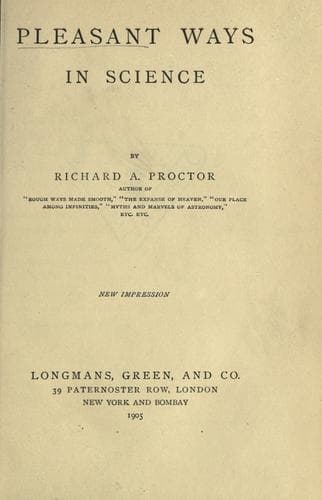
Pleasant Ways in ScienceProctor, Richard A. (Richard Anthony)
Science
Pleasant Ways in Science
Proctor, Richard A. (Richard Anthony)
Science
The case corresponding, then, to that of the purest of all human
races, and the case therefore most favourable to the view presented
by Darwin (though very far from essential to the Darwinian theory),
is simply this, that, in the first place, many animals regarded as
truly Simiadæ share descent from animals outside that family which
Darwin regards as the ape progenitor of man; and, in the second place,
many animals regarded as outside the Simiadæ share descent from that
ape-like progenitor. This involves the important inference that the
ape-like progenitor of man was not so markedly differentiated from
other families of animals then existing, that fertile intercourse
was impossible. A little consideration will show that this inference
accords well with, if it might not almost have been directly deduced
from, the Darwinian doctrine that all orders of mammals were, in
turn, descended from a still more remote progenitor race. The same
considerations may manifestly be applied also to that more remote
race, to the still more remote race from which all the vertebrates
have descended, and so on to the source itself from which all forms of
living creatures are supposed to have descended. A difficulty meets
us at that remotest end of the chain analogous to the difficulty of
understanding how life began at all; but we should profit little by
extending the inquiry to these difficulties, which remain, and are
likely long to remain, insuperable.
So far, however, are the considerations above urged from introducing
any new or insuperable objection to the Darwinian theory, that, rightly
understood, they indicate the true answer to an objection which has
been urged by Mivart and others against the belief that man has
descended from some ape-like progenitor.
Mivart shows that no existing ape or monkey approaches man more nearly
in all respects than other races, but that one resembles man more
closely in some respects, another in others, a third in yet others,
and so forth. “The ear lobule of the gorilla makes him our cousin,”
he says, “but his tongue is eloquent in his own dispraise.” If the
“bridging convolutions of the orang[’s brain] go to sustain his claim
to supremacy, they also go far to sustain a similar claim on the
part of the long-tailed thumbless spider-monkeys. If the obliquely
ridged teeth of _Simia_ and _Troglodytes_ (the chimpanzee) point to
community of origin, how can we deny a similar community of origin, as
thus estimated, to the howling monkeys and galagos? The liver of the
gibbons proclaims them almost human; that of the gorilla declares him
comparatively brutal. The lower American apes meet us with what seems
the ‘front of Jove himself,’ compared with the gigantic but low-browed
denizens of tropical Western Africa.”
Public-domain text, read in full here on John Shaqi.
Reviews
Reviews
No reviews yet
Be the first to share your thoughts on this work.
Elsewhere in the archive
Join the Discussion
Join the discussion
Sign in to leave a comment or review.
Sign InorCreate an account