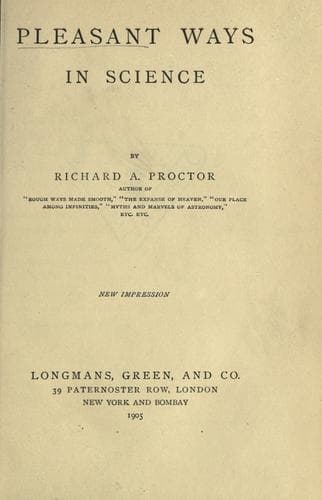
Pleasant Ways in ScienceProctor, Richard A. (Richard Anthony)
Science
Pleasant Ways in Science
Proctor, Richard A. (Richard Anthony)
Science
widened gap, we see that once the gap must have been much narrower than
it is. Lower races of man than any now known once existed on the earth,
and also races of apes nearer akin to man than any now existing, even
if the present races of apes are not the degraded descendants of races
which, living under more favourable conditions, were better developed
after their kind than the gorilla, chimpanzee, orang, and gibbon of the
present time.
It may be, indeed, that in the consideration last suggested we may find
some assistance in dealing with our difficult problem. It is commonly
assumed that the man-like apes are the most advanced members of the
Simian family save man alone, and so far as their present condition is
concerned this may be true. But it is not necessarily the case that
the anthropoid apes have advanced to their present condition. Judging
from the appearance of the young of these races, we may infer with some
degree of probability that these apes are the degraded representatives
of more intelligent and less savage creatures. Whereas the young of
man is decidedly more savage in character than the well-nurtured and
carefully trained adult, the young of apes are decidedly less savage
than the adult. The same reasoning which leads us to regard the
wildness, the natural cruelty, the destructiveness, the love of noise,
and many other little ways of young children, as reminders of a more or
less remote savage ancestry, should lead us to regard the comparative
tameness and quiet of the young gorilla, for example, as evidence that
in remote times the progenitors of the race were not so wild and fierce
as the present race of gorillas.
But even when all such considerations, whether based on the known or
the possible, have been taken into account, the gap between the lowest
savage and the highest ape is not easily bridged. It is easier to see
how man _may_ have developed from an arboreal, unspeaking animal to his
present state, than to ascertain how any part of the development was
actually effected; in other words, it is easier to suggest a general
hypothesis than to establish an even partial theory.
Public-domain text, read in full here on John Shaqi.
Reviews
Reviews
No reviews yet
Be the first to share your thoughts on this work.
Elsewhere in the archive
Join the Discussion
Join the discussion
Sign in to leave a comment or review.
Sign InorCreate an account