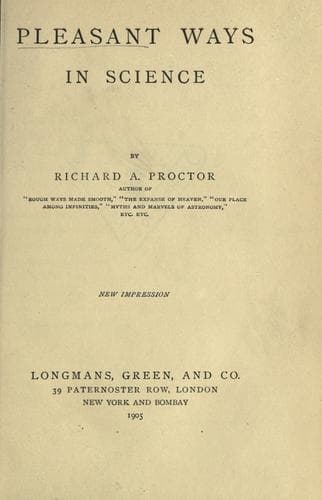
Pleasant Ways in ScienceProctor, Richard A. (Richard Anthony)
Science
Pleasant Ways in Science
Proctor, Richard A. (Richard Anthony)
Science
The human body has been compared to a lamp in which a flame is burning.
In some respects the comparison is a most apt one, as we shall see
presently. But man does more than _live_; he _works_,—with his
brain or with his muscles. And therefore the human frame may be more
justly compared to a steam-engine than to the flame of a lamp. Of
mere life, the latter illustration is sufficiently apt, but it leaves
unillustrated man’s capacity for work; and since food is taken with
two principal objects—the maintenance of life and the renewal of
material used up in brain work and muscular work—we shall find that
the comparison of man to a machine affords a far better illustration
of our subject than the more common comparisons of the life of man
to a burning flame, and of food to the fuel which serves to maintain
combustion.
There is, however, one class of food, and, perhaps, on the whole, the
most important, the operation of which is equally well illustrated by
either comparison. The sort of food to which I refer may be termed
_heat-maintaining_ food. I distinguish it thus from food which serves
other ends, but of course it is not to be understood that any article
of diet serves _solely_ the end of maintaining heat. Accordingly, we
find that heat-maintaining substance exists in nearly all the ordinary
articles of food. Of these there are two—sugar and fat—which may be
looked on as special “heat-givers.” Starch, also, which appears in all
vegetables, and thus comes to form a large proportion of our daily
food, is a heat-giver. In fact, this substance only enters the system
in the form of sugar, the saliva having the power of converting starch
(which is insoluble in water) into sugar, and thus rendering it soluble
and digestible.
Public-domain text, read in full here on John Shaqi.
Reviews
Reviews
No reviews yet
Be the first to share your thoughts on this work.
Elsewhere in the archive
Join the Discussion
Join the discussion
Sign in to leave a comment or review.
Sign InorCreate an account