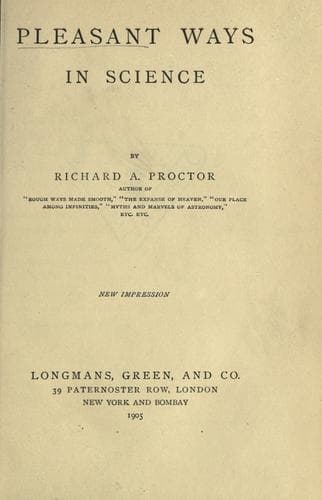
Pleasant Ways in ScienceProctor, Richard A. (Richard Anthony)
Science
Pleasant Ways in Science
Proctor, Richard A. (Richard Anthony)
Science
That was written a quarter of a century ago, when spectroscopic
analysis, as we now know it, had no existence. Accordingly, while the
fatal objection to Doppler’s original theory is overlooked on the
one hand, the means of applying the principle underlying the theory,
in a much more exact manner than Doppler could have hoped for, is
overlooked on the other. Both points are noted in the article above
referred to, in the same paragraph. “We may dismiss,” I there stated,
“the theory started some years ago by the French astronomer, M.
Doppler.” But, I presently added, “It is quite clear that the effects
of a motion rapid enough to produce such a change” (_i.e._ a change
of tint in a pure colour) “would shift the position of the whole
spectrum—and this change would be readily detected by a reference
to the spectral lines.” This is true, even to the word “readily.”
Velocities which would produce an appreciable change of tint would
produce “readily” detectible changes in the position of the spectral
lines; the velocities actually existing among the star-motions would
produce changes in the position of these lines detectible only with
extreme difficulty, or perhaps in the majority of instances not
detectible at all.
It has been in this way that the spectroscopic method has actually been
applied.
It is easy to perceive the essential difference between this way of
applying the method and that depending on the attempted recognition
of changes of colour. A dark line in the spectrum marks in reality
the place of a missing tint. The tints next to it on either side are
present, but the tint between them is wanting. They are changed in
colour—very slightly, in fact quite inappreciably—by motions of
recession or approach, or, in other words, they are shifted in position
along the spectrum, towards the red end for recession, towards the
violet end for approach; and of course the dark space between is
shifted along with them. One may say that the missing tint is changed.
For in reality that is precisely what would happen. If the light of
a star at rest gave every tint of the spectrum, for instance, except
mid-green alone, and that star approached or receded so swiftly that
its motion would change pure green light to pure yellow in one case,
or pure blue in the other, then the effect on the spectrum of such a
star would be to throw the dark line from the middle of the green part
of the spectrum to the middle of the yellow part in one case, or to
the middle of the blue part in the other. The dark line would be quite
notably shifted in either case. With the actual stellar motions, though
all the lines are more or less shifted, the displacement is always
exceedingly minute, and it becomes a task of extreme difficulty to
recognize, and still more to measure, such displacement.
Public-domain text, read in full here on John Shaqi.
Reviews
Reviews
No reviews yet
Be the first to share your thoughts on this work.
Elsewhere in the archive
Join the Discussion
Join the discussion
Sign in to leave a comment or review.
Sign InorCreate an account