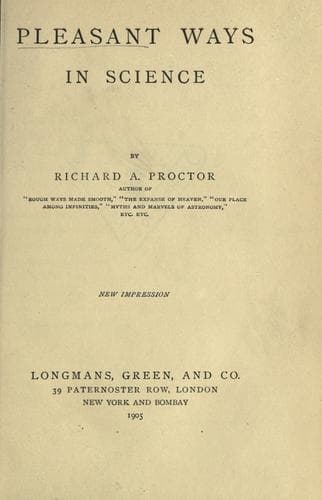
Pleasant Ways in ScienceProctor, Richard A. (Richard Anthony)
Science
Pleasant Ways in Science
Proctor, Richard A. (Richard Anthony)
Science
He turned to the other pointer, and found it rapidly receding
from the earth. Being under the impression that my five included both
pointers, he concluded that my prediction had utterly failed, and so
went on with his observations, altogether unprejudiced in its favour,
to say the least. The next star of the seven he found to be receding
at the same rate as the second pointer; the next at the same rate,
the next, and the next receding still at the same rate, and lastly
the seventh receding at a different rate. Here, then, were five stars
all receding at a common rate, and of the other two one receding at
a different rate, the other swiftly approaching. Turning next to the
work containing my prediction, Huggins found that the five stars thus
receding at a common rate were the five whose community of motion I
had indicated two years before. Thus the first prediction ever made
respecting the motions of the so-called fixed stars was not wanting in
success. I would venture to add that the theory of star-drift, on the
strength of which the prediction was made, was in effect demonstrated
by the result.
The next application of the new method was one of singular interest. I
believe it was Mr. Lockyer who first thought of applying the method to
measure the rate of solar hurricanes as well as the velocities of the
uprush and downrush of vaporous matter in the atmosphere of the sun.
Another spectroscopic method had enabled astronomers to watch the rush
of glowing matter from the edge of the sun, by observing the coloured
flames and their motions; but by the new method it was possible to
determine whether the flames at the edge were swept by solar cyclones
carrying them from or towards the eye of the terrestrial observer,
and also to determine whether glowing vapours over the middle of the
visible disc were subject to motion of uprush, which of course would
carry them towards the eye, or of downrush, which would carry them
from the eye. The result of observations directed to this end was to
show that at least during the time when the sun is most spotted, solar
hurricanes of tremendous violence take place, while the uprushing and
downrushing motions of solar matter sometimes attain a velocity of more
than 100 miles per second.
Public-domain text, read in full here on John Shaqi.
Reviews
Reviews
No reviews yet
Be the first to share your thoughts on this work.
Elsewhere in the archive
Join the Discussion
Join the discussion
Sign in to leave a comment or review.
Sign InorCreate an account