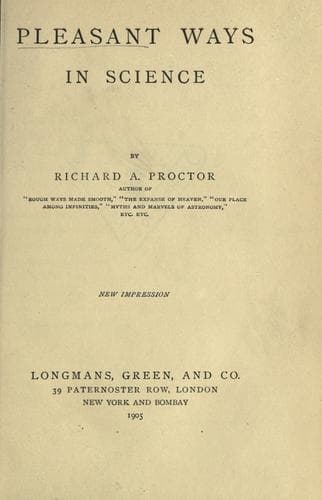
Pleasant Ways in ScienceProctor, Richard A. (Richard Anthony)
Science
Pleasant Ways in Science
Proctor, Richard A. (Richard Anthony)
Science
This theory corresponds far better also with observed facts than the
theory of Meyer and Klein, in other respects than simply in antecedent
probability. It can easily be shown that if a planet fell upon a
sun in such sort as to become part of his mass, or if a nebula in a
state of intense heat excited the whole frame of a star to a similar
degree of heat, the effects would be of longer duration than the
observed accession of heat and light in the case of all the so-called
“new stars.” It has been calculated by Mr. Croll (the well-known
mathematician to whom we owe the most complete investigations yet made
into the effect of the varying eccentricity of the earth’s orbit on the
climate of the earth) that if two suns, each equal in mass to one-half
of our sun, came into collision with a velocity of 476 miles per
second, light and heat would be produced which would cover the present
rate of the sun’s radiation for fifty million years. Now although it
certainly does not follow from this that such a collision would result
in the steady emission of so much light and heat as our sun gives out,
for a period of fifty million years, but is, on the contrary, certain
that there would be a far greater emission at first and a far smaller
emission afterwards, yet it manifestly must be admitted that such a
collision could not possibly produce so short-lived an effect as we see
in the case of every one of the so-called new stars. The diminution
in the emission of light and heat from the maximum to one-half the
maximum would not occupy fifty millions of years, or perhaps even five
million or five hundred thousand years; but it would certainly require
thousands of years; whereas we have seen that the new stars in the
Crown and in the Swan have lost not one-half but ninety-nine hundredths
of their maximum lustre in a few months.
Public-domain text, read in full here on John Shaqi.
Reviews
Reviews
No reviews yet
Be the first to share your thoughts on this work.
Elsewhere in the archive
Join the Discussion
Join the discussion
Sign in to leave a comment or review.
Sign InorCreate an account