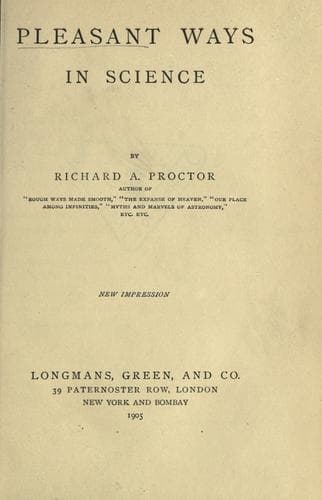
Pleasant Ways in ScienceProctor, Richard A. (Richard Anthony)
Science
Pleasant Ways in Science
Proctor, Richard A. (Richard Anthony)
Science
The reasoning, however, if not altogether unsatisfactory, is by no
means so conclusive as Herr Vögel appears to think. It is not clear how
the incandescent portion of the surface could possibly cool in any
great degree while enormous quantities of gas more intensely heated (by
the hypothesis) remained around the star. The more rapid decrease in
the violet and blue parts of the spectrum than in the red and orange
is explicable as an effect of absorption, at least as readily as by
the hypothesis that burning solid or liquid matter had cooled. Vögel
himself could only regard the other bands which crossed the spectrum
as absorption-bands. And the absorption of light from the continuous
spectrum in these parts (that is, not where the bright lines belonging
to the gaseous matter lay) could not possibly result from absorption
produced by those gases. If other gases were in question, gases which,
by cooling with the cooling surface, had become capable of thus
absorbing light from special parts of the spectrum, how is it that
before, when these gases were presumably intensely heated, they did not
indicate their presence by bright bands? Bright bands, indeed, were
seen, which eventually faded out of view, but these bright bands did
not occupy the position where, later on, absorption-bands appeared.
The natural explanation of what had thus far been observed is different
from that advanced by Vögel, though we must not assume that because
it is the natural, it is necessarily the true explanation. It is
this—that the source of that part of the star’s light which gave the
bright-line spectrum, or the spectrum indicative of gaseity, belongs
to the normal condition of the star, and not to gases poured forth,
in consequence of some abnormal state of things, from the sun’s
interior. We should infer naturally, though again I say not _therefore_
correctly, that if a star spectroscope had been directed upon the
place occupied by the new star before it began to shine with unusual
splendour, the bright-line spectrum would have been observed. Some
exceptional cause would then seem to have aroused the entire surface
of the star to shine with a more intense brightness, the matter thus
(presumably) more intensely heated being such as would give out the
combined continuous and bright-line spectrum, including the bright
lines which, instead of fading out, shone with at least relatively
superior brightness as the star faded from view. The theory that, on
the contrary, the matter giving these more persistent lines was that
whose emission caused the star’s increase of lustre, seems at least not
proven, and I would go so far as to say that it accords ill with the
evidence.
Public-domain text, read in full here on John Shaqi.
Reviews
Reviews
No reviews yet
Be the first to share your thoughts on this work.
Elsewhere in the archive
Join the Discussion
Join the discussion
Sign in to leave a comment or review.
Sign InorCreate an account