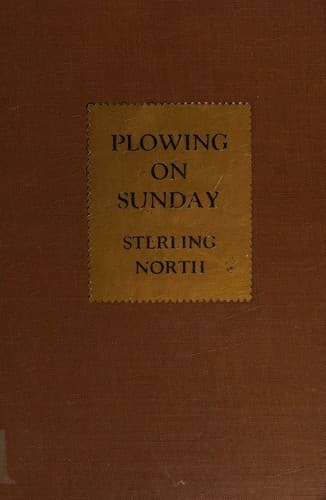
Farm life -- Fiction; United States -- Social life and customs -- 20th century -- Fiction; Wisconsin -- Fiction
Sarah, steeling herself for the ordeal; Early Ann, who pretended
she did not mind slaughtering; Gus, who had a sentimental fondness
for every animal on the place; and Stud, for whom this day was the
climax of the hog-raising season, trooped down the hill to the
slaughter house, started a fire in the stove, and carried water to
fill the great iron kettle just outside the slaughter house door.
Stud began whetting his knives on his butcher's steel, making a
sound which cut through Sarah's flesh like a blade. He liked to
whet knives. And he could not deny it, he liked to slaughter.
He had the finest butchering equipment of any farmer on Lake
Koshkonong. Sticking, boning, and skinning knives in their
rack--the steel blades and brass studs in the rosewood handles
gleaming in the lantern light; the biggest butchering kettle in the
township; the best pair of hand-wrought gambrels, hung from the
finest reel on the strongest hickory axle.
Some farmers still carried away the blood in buckets, but
Brailsford had built himself a slanting trough. His heavy cleavers
with their hickory handles, his meat saws, hog hooks, scrapers,
chopping block and sausage machine were the best that money could
buy.
As always, Sarah felt an agony which she would not show. She
could not understand that quality in Stanley which made him enjoy
killing,--enjoy going out at night to knock the sparrows out of
their nests in the straw to wring the necks of the drowsy, blinded
birds. At haying time, too, he was careless of the rabbits and
half-grown quail as he drove his mower through the timothy and
clover. Sometimes when she lay beside him at night she thought of
his God-like power to give life and to take it away.
Sarah's job on the farm was to feed, nurse and tenderly raise. She
supposed that Stud must kill. And yet it frightened her to think
that she and her family were no more secure from death than these
animals. When the time came God would take them all as easily and
with as little ceremony.
"Go get the hogs," Stud shouted to Gus. "And, Early Ann, you start
the fire under the kettle."
Out of their warm hog house the pigs and sows were driven by
the hired man's boots. They were herded across the pig yard,
littered with thousands of corn cobs from the tons of corn they
had eaten. They went in a complaining, squealing drove past the
soul-satisfying mudholes (now frozen) where they had wallowed
during the summer. They grunted and clambered over one another as
they were shunted into the slaughter house.
Early Ann, meanwhile, was starting the great fire of hickory and
oak under the black iron kettle mounted on its tripod. The red
and yellow flames licked up around the kettle, made a scene in the
darkness which might have accompanied an early witchburning on
the wind-swept New England shore. Sarah was singing a hymn as she
cleaned the sausage machine:
"_Sweet the Sabbath morning,
Cool and bright returning...._"
Then:
Public-domain text, read in full here on John Shaqi.
Reviews
Reviews
No reviews yet
Be the first to share your thoughts on this work.
Elsewhere in the archive
Join the Discussion
Join the discussion
Sign in to leave a comment or review.
Sign InorCreate an account