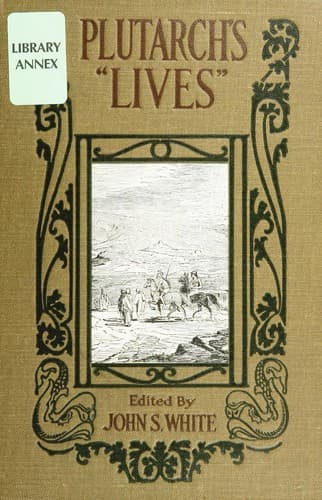
Plutarch: Lives of the noble Grecians and RomansPlutarch
PhilosophyPhilosophy
Plutarch: Lives of the noble Grecians and Romans
Plutarch
Greece -- Biography -- Early works to 1800; Rome -- Biography -- Early works to 1800
Hippias the sophist says that Lycurgus himself was a great soldier and
an experienced commander. Philostephanus attributes to him the first
division of the cavalry into troops of fifties in a square body; but
Demetrius the Phalerian says quite the contrary, and that he made all
his laws in a continued peace. And, indeed, the Olympic holy truce, or
cessation of arms, that was procured by his means and management,
inclines me to think him a kind-natured man, and one that loved
quietness and peace. Notwithstanding all this, Hermippus tells us that
he had no hand in the ordinance; that Iphitus made it, and Lycurgus came
only as a spectator, and that by mere accident too. Being there, he
heard as it were a man's voice behind him, blaming and wondering at him
that he did not encourage his countrymen to resort to the assembly, and,
turning about and seeing no man, concluded that it was a voice from
heaven, and upon this immediately went to Iphitus, and assisted him in
ordering the ceremonies of that feast, which, by his means, were better
established, and with more repute than before.
To return to the Lacedaemonians. Their discipline continued still after
they were full-grown men. No one was allowed to live after his own
fancy; but the city was a sort of camp, in which every man had his share
of provisions and business set out, and looked upon himself not so much
born to serve his own ends as the interest of his country. Therefore,
if they were commanded nothing else, they went to see the boys perform
their exercises, to teach them something useful, or to learn it
themselves of those who knew better. And, indeed, one of the greatest
and highest blessings Lycurgus procured his people was the abundance of
leisure, which proceeded from his forbidding to them the exercise of any
mean and mechanical trade. Of the money-making that depends on
troublesome going about and seeing people and doing business, they had
no need at all in a state where wealth obtained no honor or respect.
The Helots tilled their ground for them, and paid them yearly in kind
the appointed quantity, without any trouble of theirs. To this purpose
there goes a story of a Lacedaemonian who, happening to be at Athens
when the courts were sitting, was told of a citizen that had been fined
for living an idle life, and was being escorted home in much distress of
mind by his condoling friends; the Lacedaemonian was much surprised at
it, and desired his friend to show him the man who was condemned for
living like a freeman. So much beneath them did they esteem the
frivolous devotion of time and attention to the mechanical arts
and to money-making.
Public-domain text, read in full here on John Shaqi.
Reviews
Reviews
No reviews yet
Be the first to share your thoughts on this work.
Elsewhere in the archive
Join the Discussion
Join the discussion
Sign in to leave a comment or review.
Sign InorCreate an account