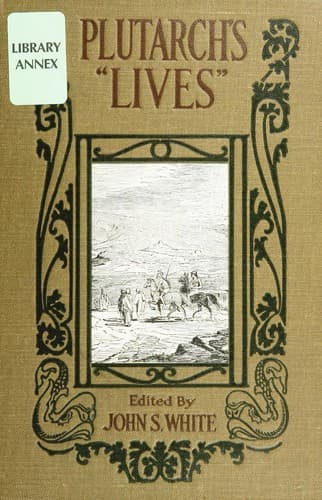
Plutarch: Lives of the noble Grecians and RomansPlutarch
PhilosophyPhilosophy
Plutarch: Lives of the noble Grecians and Romans
Plutarch
Greece -- Biography -- Early works to 1800; Rome -- Biography -- Early works to 1800
In like manner Numa spoke of a certain goddess or mountain nymph that
was in love with him, and met him in secret, as before related; and
professed that he entertained familiar conversation with the Muses, to
whose teaching he ascribed the greatest part of his revelations; and
amongst them, above all, he recommended to the veneration of the Romans
one in particular, whom he named Tacita, the Silent; which he did
perhaps in imitation and honor of the Pythagorean silence. His opinion,
also, of images is very agreeable to the doctrine of Pythagoras; who
conceived of the first principle of being as transcending sense and
passion, invisible and incorrupt, and only to be apprehended by abstract
intelligence. So Numa forbade the Romans to represent God in the form
of man or beast, nor was there any painted or graven image of a deity
admitted amongst them for the space of the first hundred and seventy
years, all which time their temples and chapels were kept free and pure
from images; to such baser objects they deemed it impious to liken the
highest, and all access to God impossible, except by the pure act of the
intellect. His sacrifices, also, had great similitude to the ceremonial
of Pythagoras, for they were not celebrated with effusion of blood, but
consisted of flour, wine, and the least costly offerings. Other
external proofs, too, are urged to show the connection Numa had with
Pythagoras. The comic writer Epicharmus, an ancient author, and of the
school of Pythagoras, in a book of his dedicated to Antenor, records
that Pythagoras was made a freeman of Rome. Again, Numa gave to one of
his four sons the name of Mamercus, which was the name of one of the
sons of Pythagoras; from whence, as they say sprang that ancient
patrician family of the Aemilii, for that the king gave him in sport the
surname of Aemilius, for his engaging and graceful manner in speaking.
I remember, too, that when I was at Rome, I heard many say, that, when
the oracle directed two statues to be raised, one to the wisest, and
another to the most valiant man of Greece, they erected two of brass,
one representing Alcibiades, and the other Pythagoras.
Public-domain text, read in full here on John Shaqi.
Reviews
Reviews
No reviews yet
Be the first to share your thoughts on this work.
Elsewhere in the archive
Join the Discussion
Join the discussion
Sign in to leave a comment or review.
Sign InorCreate an account